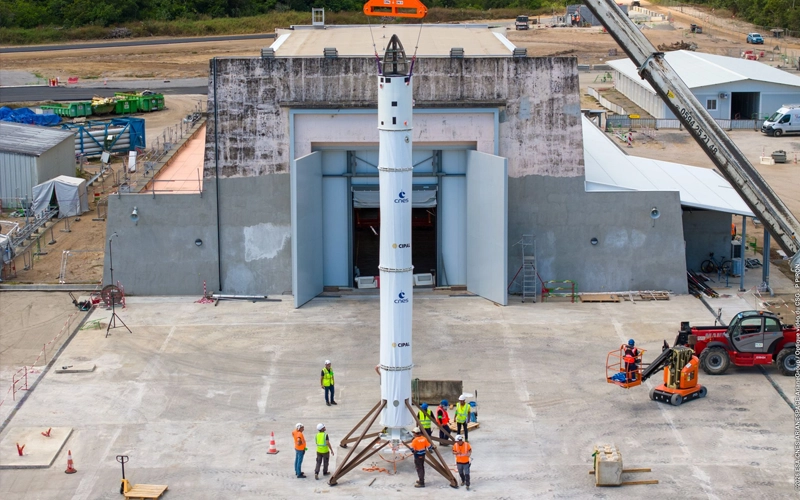
The French space agency CNES has announced the start of ground qualification testing for the Callisto reusable rocket demonstrator at the Guiana Space Centre. A full-scale mockup of the vehicle has been erected at the space centre’s former Diamant launch facility, which is being redeveloped to support the programme.
In a 29 October announcement, CNES explained that the full-scale mockup, manufactured by French company CIPAL, will be used to test and validate ground systems, interfaces between the vehicle and ground infrastructure, and associated operational procedures.
According to the French space agency, teams are currently conducting a week-long campaign to test communications between the launch base and the vehicle. The tests are intended to ensure reliable communications during take-off and, in particular, during the vehicle’s descent.
In an update published on 3 August, the German Aerospace Center (DLR) stated that Callisto’s inaugural flight was expected to take place in 2027. With ground qualification now underway, CNES’s latest announcement appears consistent with that timeline, although the agency did not explicitly corroborate that target.
The French space agency explained that ground testing will continue into 2027, “paving the way for the arrival of the flight vehicle shortly afterwards.” However, it offered no clarification on what exactly “shortly afterwards” means.
Earlier this month, DLR provided the most recent update on the development of the vehicle itself. In a 5 October LinkedIn post, the German aerospace agency reported that engineers from its Institute of Space Systems and Institute of Structures and Design had conducted a series of deployment tests on the vehicle’s landing legs.
The tests were carried out using a specially designed test stand at DLR’s Landing and Mobility Test Facility (LAMA), allowing engineers to simulate realistic deployment conditions. The development campaign followed earlier vibration testing intended to replicate the stresses experienced during launch.