The French space agency CNES has issued a call for new automated optical tracking systems for the Guiana Space Centre. The new system will need to be capable of tracking launch vehicles to altitudes of up to an altitude of 100 kilometres.
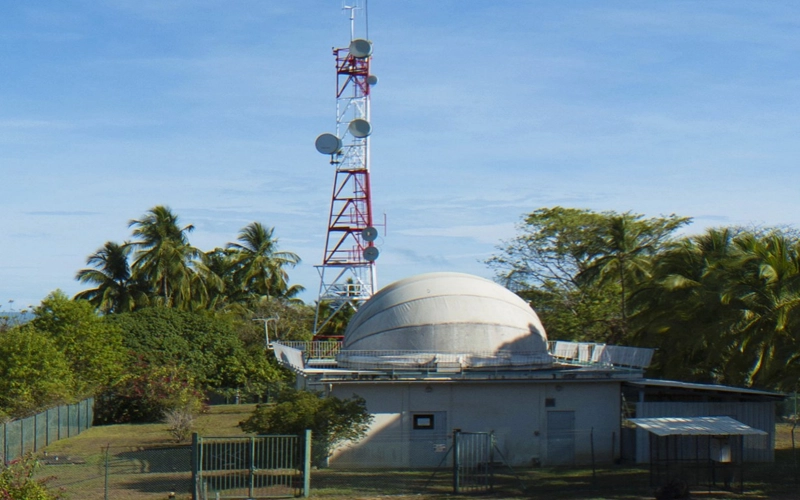
Published on 24 September, the initiative aims to replace aging and partially obsolete equipment currently used to capture imagery of Ariane and Vega launches. CNES said the existing systems are ageing and partially obsolete. The agency wants to replace the manual and semi-automated systems with a fully automated alternative, with tracking tied directly to launch vehicle trajectory data.
Beyond launch imagery for public broadcasts, the spaceport’s flight-safety teams use these systems for technical analysis and diagnostics to support post-launch investigations.
The new tracking turrets will carry sensors operating in both the visible and infrared spectrum, together with very-long-focal-length optics capable of clearly observing a launch vehicle at an altitude of 100 kilometres.
In total, CNES plans to procure three turrets. Two will be fixed systems, while the third will be a mobile unit that can be positioned where it’s needed. CNES will install one fixed turret on Île Royale, an island off the coast of French Guiana, and the second on the mainland.
The turrets will be managed remotely and operated from a single console at the Image Production Centre (Centre de Production d’Images) in the Jupiter 2 building, which is also home to the spaceport’s main control centre.
CNES expects to award the contract in the third quarter of 2027. The contract, covering the supply, installation and qualification of the new systems, is expected to run for approximately three years.