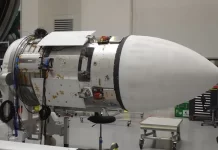
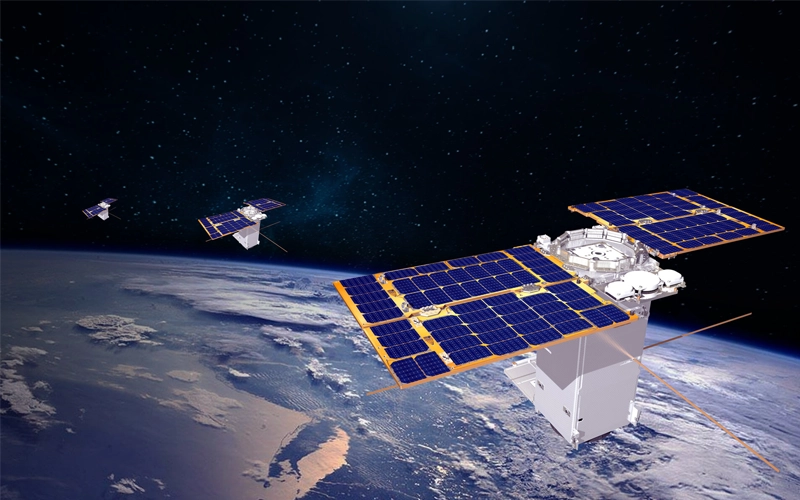
The French space agency CNES is looking for an industrial partner to develop and qualify a compact optical telescope for future satellite constellations. The agency says the design must be suitable for mass production, with production volumes exceeding 1,000 units.
According to a request for information (RFI) published on 18 August, the project is aimed at turning a CNES-defined optical design into a compact, low-cost telescope that can be manufactured rapidly and at scale for future constellations. The agency says the telescope could support a broad range of imaging applications, including detection, surveillance and identification.
The RFI outlines that the telescopes should measure no more than 200 by 200 by 100 millimetres. The proposed manufacturing technique (diamond machining) focuses on rapid production, while the proposed material (aluminium with a reflective coating) is intended to keep costs low. The telescope would incorporate multiple mirrors on a single substrate and be designed so that its optics do not require adjustment during assembly.
Starting from an optical design produced by CNES, which the agency says “has reached a very advanced stage,” the industrial partner would be expected to complete the telescope’s design and assess its performance under thermal and mechanical stresses. CNES expects to begin demonstration activities before the end of 2026, with qualification targeted for 2027 or 2028.
While the agency avoids identifying any specific applications for the mass-produced compact telescope, the project fits within a broader CNES push to develop smaller, lower-cost optical systems for high-revisit missions. In its 2024 optical-imaging technology roadmap, the agency identified the development of compact telescopes for NewSpace missions as one of six priority areas, a focus that was retained in its 2025 technical policy.
There is, however, some indication that potential applications for the telescopes could be dual-use or even defence-focused. Detection, surveillance and identification are terms commonly used in reconnaissance and defence-imaging contexts. The addition of that terminology in the RFI does not mean the telescope is being developed specifically for military use, but it does point to, at the very least, potential dual-use applications alongside more conventional civil Earth observation.