
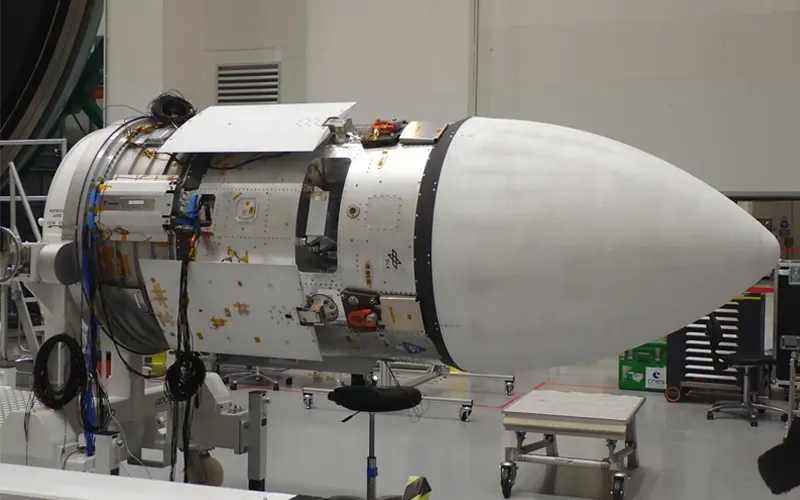
The German Aerospace Center (DLR) has completed final testing of the nose cone for the Callisto reusable rocket demonstrator, with the hardware now set to be transferred to France for final integration. DLR has also confirmed that the demonstrator’s initial hop test has slipped to 2027, a delay first hinted at in a French space agency (CNES) procurement notice published in September 2025.
DLR announced on 11 September that the nose cone had successfully completed acceptance testing. The carbon-fibre structure will be delivered to the French space agency CNES and APCO Technologies for integration into Callisto’s top block before it is shipped to the Guiana Space Centre.
This latest announcement is one of several recent indications of progress being made on the vehicle’s flight hardware, with DLR also confirming that Callisto’s aerodynamic fins are complete and its landing legs are currently being manufactured. DLR added that the landing legs are expected to be shipped to the launch site in 2027. In addition to Germany’s contributions, recent procurement records and supplier updates show work continuing on contributions from CNES and JAXA to the vehicle, including propulsion, control and integration hardware.
On 21 August, Kristian Lium, vice president of space at Norwegian aerospace and defence company Nammo, said a hydrogen-peroxide propulsion system built by the company was being delivered to CNES for use aboard Callisto. The system will power the vehicle’s reaction control system, which consists of eight thrusters used to control its attitude during flight.
Procurement records from JAXA provide a glimpse into work being done on the lower propulsion section of the vehicle. During 2026, the agency has procured the manufacture of large stainless-steel piping for Callisto’s RSR-2 engine, cryogenic and gas quick-disconnect systems, and modifications to flight-control hardware. JAXA has also been preparing for standalone turbopump testing.
Once assembled in Japan, Callisto’s propulsion block is expected to undergo a hot-fire campaign at JAXA’s Noshiro Test Center before being shipped to French Guiana for final integration. No announcement confirming that this campaign has begun has yet been made.
Preparations are also continuing at the Guiana Space Centre to build out the launch and landing facilities for the vehicle’s hop-test campaign. The facilities are being built on the grounds of the former Diamant launch complex, which is also being transformed into a multi-user launch complex that will play host to PLD Space, Isar Aerospace, Rocket Factory Augsburg, Latitude and Sirius Space.
In December 2025, CNES published a call for a 40-foot liquid-hydrogen container to provide propellant storage for Callisto during operations in French Guiana, with the equipment potentially required for up to 24 months. More recently, in June, the agency issued a call for civil works covering several areas of the launch complex’s transformation, including the liquid-oxygen and hydrogen-peroxide storage areas and the access road leading to the Callisto launch site.
The 2027 campaign is expected to involve eight increasingly demanding test flights and two final demonstration flights over approximately eight months. Early flights are expected to focus on low-altitude hops. The final flights will include more complex downrange trajectories, aerodynamic manoeuvres and propulsive returns.


Are these the hop tests that where supposed to happen in 2024, 2025 and then 2026? Callisto is like nuclear fusion: always one year away.
The very same, yes. This is the first time we’re seeing actual hardware, though. So, I do think we’re close.
What about Themis?
I have been trying to get an update on Themis. No luck just yet.
Themis vs Calisto, which of the two do you think has the higher chance of a successful rollout?