Italian rocket manufacturer Avio has scaled back plans to develop two liquid-fuelled rocket demonstrators intended to validate technologies for a future reusable launch vehicle.
In its half-year financial report published on 10 September, Avio disclosed that it had agreed to revise the scope and funding of its Space Transportation System (STS) programme, which originally aimed to develop and launch two demonstrators to validate its new MR10 and MR60 methalox engines and test technologies for a future reusable launch system.
“This program saw certain technical difficulties arise in connection with the development activities, which proved to be more complex than expected,” the report explained. “An analysis of the situation led [by] ESA, in agreement with Avio, to amend the contract, reducing the scope of work and partially reducing the funding.”
The company added that additional technical difficulties may still arise before the project is completed.
Under the original programme, Avio planned to develop two rocket demonstrators, beginning with a single-stage vehicle powered by the company’s MR10 engine, which is being developed for the upper stage of its future Vega E rocket. This would have been followed by a two-stage demonstrator incorporating both the MR10 and MR60 engines, the latter of which is being developed under a separate project.
Avio was awarded €217.5 million in funding for its STS programme in June 2022. This included €64 million from Italy’s EU-funded National Recovery and Resilience Plan (PNRR), €36 million from its nationally funded National Complementary Plan (PNC), and €117.5 million in additional Italian public funding.
Under the original contractual timetable, Avio was required to complete the launch programme for its first flight demonstrator by November 2026. That deadline was already under pressure by March 2026, when Avio disclosed that the programme was experiencing development delays. In its 2025 annual financial report, published on 31 March, Avio stated that the STS programme had “encountered several development challenges resulting in schedule delays.” The company added that ESA, as the implementing body, had been asked to review its progress to “access potential impacts on the contract’s scope and duration.”
While Avio has now confirmed that the scope of the programme and the funding allocated to it have been adjusted, it did not offer specifics. According to OpenPNRR, an independent monitoring platform operated by the Italian non-profit Fondazione Openpolis using government expenditure data, approximately €101.1 million in spending had been recorded against the programme, representing 46.47% of the original €217.5 million allocation.
Where the programme stands
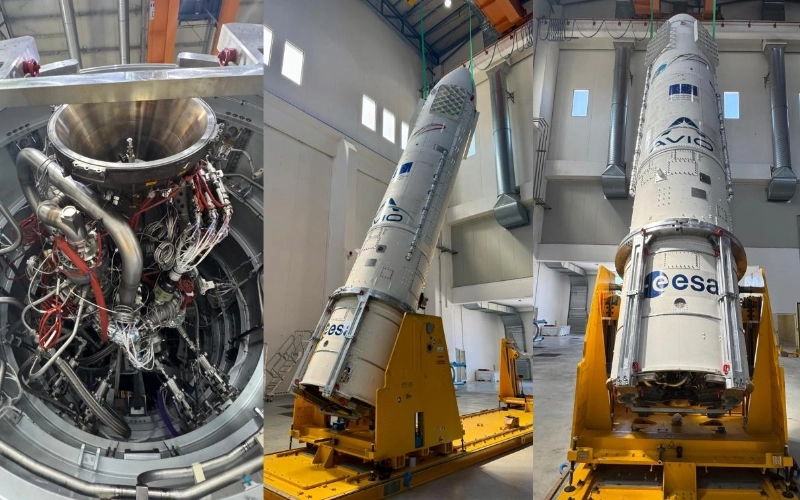
In a 10 September presentation accompanying its half-year financial results, the company revealed that the single-stage flight demonstrator (FD1) had been fully integrated, with ground testing expected to be completed by the end of 2026.
The FD1 vehicle is expected to be launched from the Italian Ministry of Defence’s Salto di Quirra test range on the east coast of Sardinia. According to environmental documents filed by Avio in March 2026, the company is constructing a temporary launch complex at the site. The infrastructure, which was originally scheduled to be commissioned by November 2026, will be dismantled and the site restored once the launch has been conducted.