Environmental documents filed in Sardinia have revealed new details about Avio’s planned FD1 suborbital demonstrator flight test. The test will utilize a temporary launch facility being erected on the grounds of the Salto di Quirra Interforce Test Range.
The 6.3-tonne single-stage demonstrator is being developed under a €181.6 million contract from the Italian government, funded through its €191.5 billion National Recovery and Resilience Plan (PNRR). The demonstrator is expected to validate key building blocks for Avio’s next-generation launch vehicles beyond Vega E.
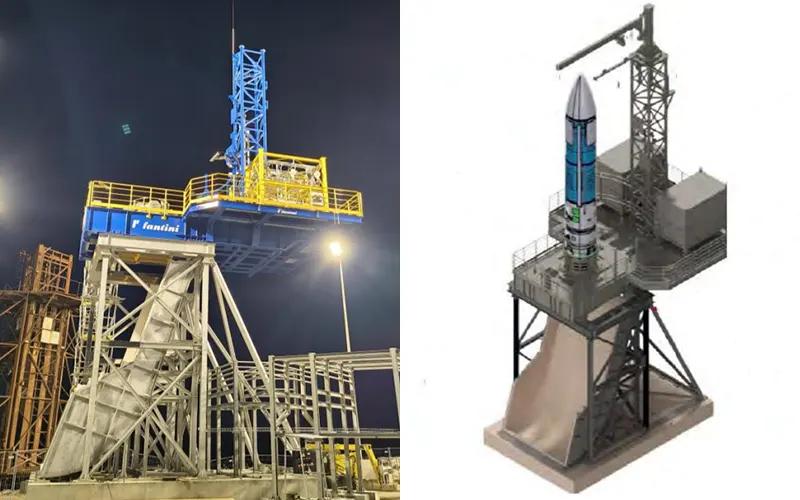
Documents filed by the company with Sardinia’s regional environmental authority on 17 March 2026 show that the FD1 demonstrator will be launched from the Italian Ministry of Defence’s Salto di Quirra test range on the island’s east coast. Avio is establishing a temporary launch complex at the test range that will later be removed, with the documents outlining that the site must be fully restored once activities are complete.
The launch complex will include storage and handling systems for liquid methane, liquid oxygen, and liquid nitrogen, telemetry and remote-control equipment, power generation, and fire suppression. The elevated launch pad is anchored to concrete blocks resting on the ground, with no groundworks taking place. According to the documents, construction was scheduled to begin in May, with commissioning of the site expected to be concluded in November.
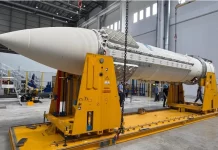
In a presentation delivered at the Mediobanca CEO Conference in Milan on 23 June, Avio said construction of the FD1 testing facility was ongoing, with photographs showing that significant work had already been completed on the launch pad. The update also said that the integration of the FD1 demonstrator was progressing, highlighting the DMX2 rocket engine, the flight-configured version of the company’s MR10 methalox engine, avionics, and the vehicle’s liquid oxygen and methane propellant tanks.
Neither the documents nor the presentation provides an estimated launch date. However, Avio’s nine-month 2025 financial report, published on 28 October 2025, indicated that the FD1 flight demonstration was expected in 2026.
The documents submitted by Avio do, however, provide the first detailed look at how the FD1 demonstration will unfold. The MR10 rocket engine will power the vehicle to an altitude of around 40 kilometres before shutting down, after which it will coast to a maximum altitude of roughly 70 kilometres. During the vehicle’s descent, the engine will be reignited at partial thrust for around 8.5 seconds before shutting down again. It will then continue on its descent unpowered, splashing down approximately 400 seconds after liftoff, around 20 kilometres from where it was launched. After splashdown, the vehicle is expected to be recovered.
In its filings, Avio outlines six main objectives for the flight: verifying the functional behaviour of the MR10 engine, validating pre-ignition operations, assessing propellant management, monitoring stage temperatures during ascent and in low-gravity conditions, demonstrating vehicle-control manoeuvres, and attempting an engine restart during descent.
With commissioning of the site only expected to be concluded in November, Avio would have only a narrow window before the end of the year to complete final launch preparations and conduct the flight if it is to meet its 2026 target.