Italian launch services provider Avio has successfully completed its second Vega-C flight of 2026, deploying the European Commission’s third Sentinel-3 Earth observation satellite and ESA’s FLEX mission.
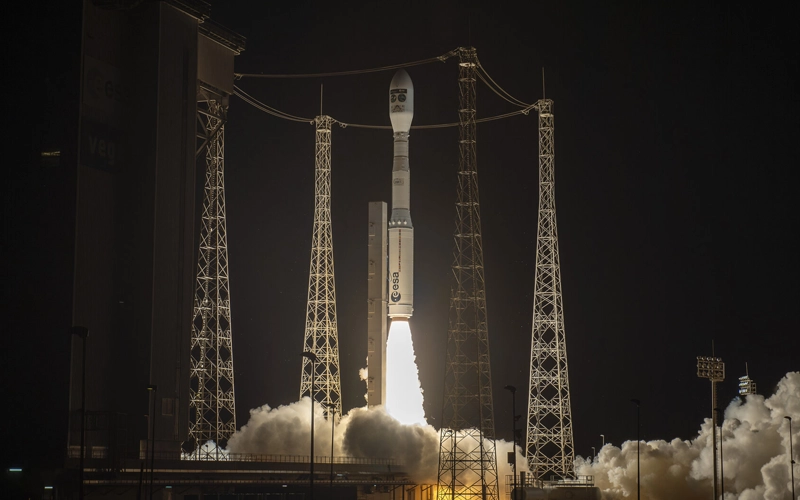
The Vega-C rocket lifted off from the Guiana Space Centre at 01:21 UTC on 15 September. Following two burns of the rocket’s AVUM+ upper stage, Sentinel-3C was deployed approximately one hour into the mission. The stage then performed two further burns before deploying ESA’s FLEX spacecraft 56 minutes later. The successful mission marked Avio’s second Vega C flight since the Italian company assumed launch service and operational responsibilities following its split from Arianespace.
“Today’s success confirms Avio as a reliable Launch Service Operator for Vega C launches,” said Avio CEO Giulio Ranzo. “The launcher performed flawlessly, putting [into] orbit two strategic satellites for Europe that demonstrate how space technologies have become essential in addressing the environmental and climate change challenges.”
Sentinel-3C joins Sentinel-3A and Sentinel-3B, which were launched in 2016 and 2018, respectively. The latest addition to the constellation is eventually intended to replace Sentinel-3A, which has exceeded its planned seven-year design life and has now been operating for more than a decade. The 1.15-tonne Sentinel-3C satellite carries instruments to study Earth’s oceans, land, ice and atmosphere, monitoring sea-surface temperature, ocean colour, sea level and sea-ice characteristics.
FLEX, short for Fluorescence Explorer, is ESA’s eighth Earth Explorer mission and is designed to measure the faint fluorescent glow emitted by plants during photosynthesis. The mission is expected to produce global maps of vegetation fluorescence, allowing scientists to assess photosynthetic activity and plant health.
With its second Vega C flight of the year successfully completed, Avio will now turn its attention to the third and final launch planned for 2026. Ranzo said during a 10 September earnings call that the mission is expected to launch at the “very beginning of December” and will carry a batch of satellites for Italy’s IRIDE Earth observation constellation. Ranzo said Avio had initially expected to conduct a fourth launch this year, but “one satellite was somewhat late.”