
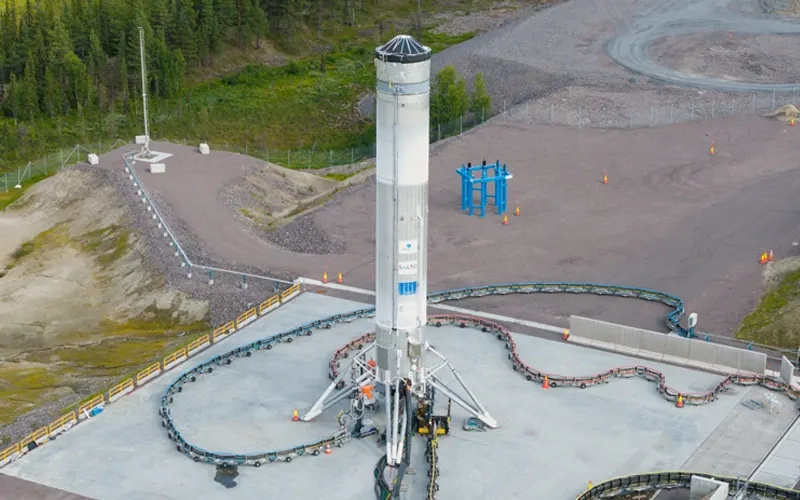
The European Commission has extended the deadline for the SALTO reusable launcher project to the end of 2026, giving the programme another three months to complete the first hop test of Europe’s Themis reusable rocket demonstrator.
According to the European Commission’s project database, the reuSable strAtegic space Launcher Technologies & Operations (SALTO) initiative is now due to be concluded on 31 December 2026. It is the latest in a series of extensions that have pushed the completion date back from the original November 2025 deadline.
The ArianeGroup-led SALTO initiative is a €42.8 million EU research project layered onto the ESA-managed Themis programme. It is funding the first two low-altitude hop tests, with the aim of demonstrating that Themis can be launched, recovered, and then launched again.
At the beginning of October, the initiative was briefly marked as closed in the EU’s project database before an update extended it to December. ESA appears to have had similar difficulty keeping its public schedule for Themis up to date.
Themis arrived at Esrange on 27 June 2025, following a two-week road journey from ArianeGroup’s Les Mureaux facility in France. Its most recent publicly announced milestone was an initial wet dress rehearsal that was completed on 23 July
Rather than using the liquid oxygen and methane that will fuel Themis in flight, the test used liquid nitrogen to safely reproduce the cryogenic temperatures and pressures expected during launch operations. ESA said the rehearsal was part of a series of tests that would be completed before the first hop test.
Update: This article was updated on 6 October to remove reference to the next milestone being a hot fire test.

You don’t have to be a psychic to predict that this new deadline will also not be met. The glacial progress of this program has now become completely ridiculous. I really wonder what has happened since the fully finished hardware arrived on site fifteen months ago. Of course we will never know that answer, because transparency is not in the vocabulary of either ESA or the European Commission.
I agree. We are talking about a strategic program involving public money here.
Do we know anything about the outcome of the latest known test? I do not expect they would tell what problems they found. But did they say ANYTHING? Can we at least know if Themis is still there?
Prime contractor ArianeGroup. Certainly not in any hurry to build competition for Ariane 6.