
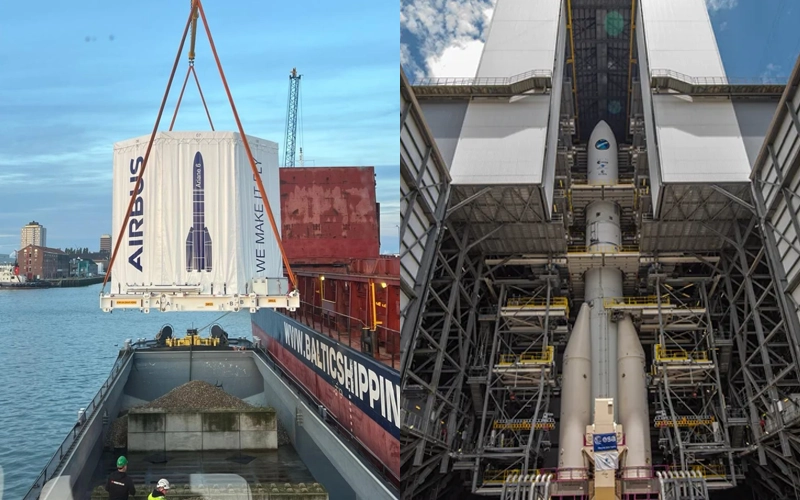
Airbus Netherlands has delivered the first lightweight Vulcain Aft Bay for Ariane 6 as part of the rocket’s Block 2 upgrades.
In a 21 October LinkedIn post, Airbus Netherlands President Rob Postma announced that the upgraded structure, designated Flight Model 16 (FM16), was on its way to ArianeGroup in France via Rotterdam. According to Postma, the upgrade is expected to be launched for the first time aboard an Ariane 6 mission in 2027.
The Vulcain Aft Bay is a structural assembly fixed to the base of Ariane 6’s main stage. It supports the Vulcain 2.1 rocket engine and transfers the thrust generated by the engine to the rocket’s main structure. The assembly currently weighs approximately five tonnes.
Postma explained that the redesigned structure is 55 millimetres shorter than its predecessor and that the assembly shipped by Airbus Netherlands is 400 kilograms lighter. However, in a subsequent clarification provided to European Spaceflight, Postma explained that the 400-kilogram figure referred to the weight reduction of the completed assembly shipped to ArianeGroup, rather than the total mass cut from Vulcain Aft Bay structure specifically.
According to Postma, Airbus Netherlands previously supplied a basic Vulcain Aft Bay structure for Ariane 6 Block 1 rockets, with ArianeGroup adding additional components during integration. Airbus Netherlands has taken on a larger share of the work for Ariane 6 Block 2, delivering the complete integrated assembly.
Despite the additional components, the completed assembly shipped by the company is 400 kilograms lighter than its Block 1 predecessor. The Block 2 Vulcain Aft Bay structure itself is 880 kilograms lighter than its predecessor.
The reduction exceeds an original 800-kilogram target outlined in July 2024 by Airbus Netherlands Director of Strategy, Sales and Business Development Frank Meiboom.
The lighter Vulcain Aft Bay is part of the Ariane 6 Block 2 evolution, which also includes the more powerful P160C solid rocket boosters. The upgraded boosters were first used aboard an Ariane 64 rocket in June 2026.
In August, European Spaceflight reported that ESA had identified the lighter Vulcain Aft Bay as one of the remaining upgrades intended to improve Ariane 6’s performance and competitiveness. While another set of upgrades, known as Block 3, had been expected to follow, ESA has since confirmed that it would not pursue them, saying there was “no programme need or justification” for doing so.
Correction, 22 October 2026: An earlier version of this article suggested that the redesigned Vulcain Aft Bay had fallen short of its original weight-reduction target. Airbus Netherlands President Rob Postma subsequently clarified that the reported 400-kilogram reduction referred to the hardware shipped by Airbus Netherlands, while the mass of complete Vulcain Aft Bay itself was reduced by 880 kilograms, exceeding the original 800-kilogram target. The article has been updated to reflect this clarification.


Hopefully they will reconsider Block 3 upgrades now, or a superheavy reusable launcher.
Those are some very different goals.
The Pegasus engine is unlikely to have been ready for the mid-decade upgrade it was announced for. And I haven’t read about any new steps in Project Adelaide.
According to the article, ESA has no interest – but that should be up to Arianespace/Group to decide (and fund)