
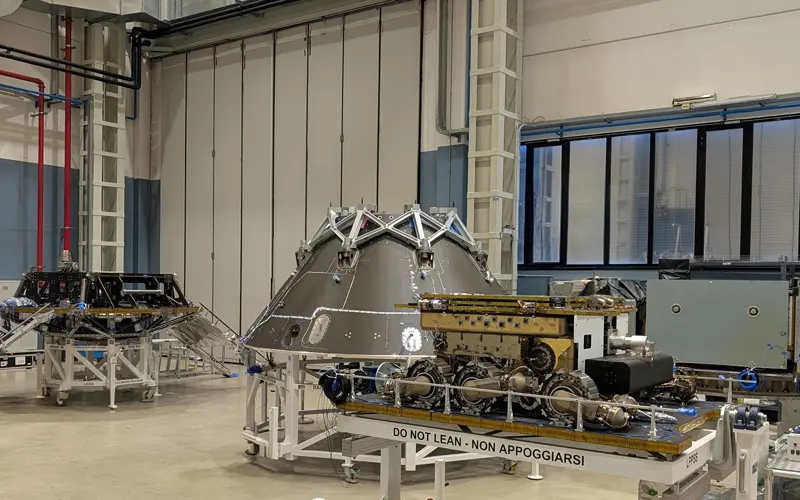
Thales Alenia Space has shipped the structural models for ESA’s ExoMars mission to its facility in Cannes for vibration and acoustic testing.
In April 2024, ESA awarded a Thales Alenia Space-led consortium a €522 million contract for the revised ExoMars mission. The company is working towards a 2028 launch window, with the mission slated to be carried to space aboard a SpaceX Falcon Heavy rocket.
On 12 May, Thales Alenia Space announced that the ExoMars structural models had been shipped to its Cannes facility after being fully integrated and qualified at the company’s Turin site for initial testing.
The structural models are essentially fully representative versions of the Rosalind Franklin rover, the Carrier Module, the Entry, Descent and Landing Module, and the Landing Platform, used to validate the mechanical design of each before the flight hardware is completed.
This first phase of testing will examine whether the structural models can withstand the rigours of a rocket launch. While Thales Alenia Space did not provide specific details about the test campaign, vibration testing generally uses a shaker table to simulate launch-like mechanical loads, while acoustic testing uses a chamber to recreate the intense sound-pressure environment of liftoff.
After the vibration and acoustic test campaigns are complete, the structural models will be shipped back to Turin for shock and separation tests. The company will then move on to testing the Proto-Flight Models, which are intended to become the flight hardware for the mission’s planned 2028 launch.
While Thales Alenia Space is making progress leading the development of the revised ExoMars mission, questions remain over whether NASA will continue to fulfil its commitments to the programme.
NASA agreed in May 2024 to provide launch services, braking engines, radioisotope heater units, and a mass spectrometer for the ExoMars mission. However, the White House’s FY2027 budget request, published in April 2026, appears to provide no funding for NASA’s Rosalind Franklin rover participation element. The proposal does, however, still have to be approved by Congress, which rejected similar large cuts to NASA’s FY2026 budget.



European Spaceflight reported just last week that ESA’s Director of Science claimed that only LISA, EnVision and NewAthena would require specific recovery actions if the proposed NASA budget cuts go through. Given the significant American participation in ExoMars, it seems wise that ESA also looks into how that mission can be saved if the Americans (once again) withdraw.