US-based space technology company Redwire has delivered an initial prototype of a robotic arm that could be used aboard the European Space Agency’s Argonaut lunar lander. The announcement comes as ESA has opened a call for proposals to demonstrate a similar system aboard the lander’s inaugural mission, which is expected to launch in 2030.
In early 2024, ESA awarded contracts to Redwire and Poland’s PIAP Space to deliver an initial prototype of the Manipulator for Argonaut Payload Needs and Unloading Support (MANUS) system, a multi-use robotic arm for its future lunar lander platform. In its 22 May 2024 press release announcing that it had been awarded a MANUS contract, Redwire explained that, under the contract, the company would build an initial prototype of the robotic arm to validate the system’s core features. It also stated that the company would then be able to “compete for a follow-on contract.”
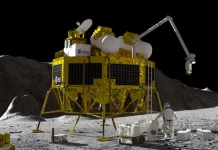
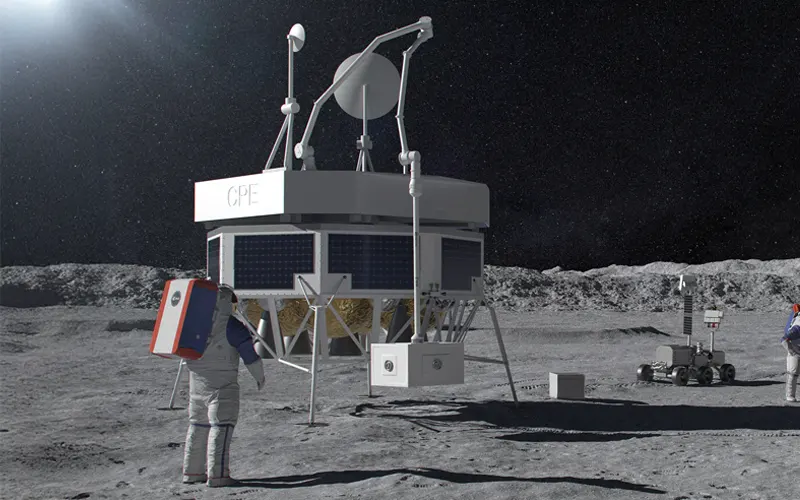
On 21 May 2026, Redwire announced that it had delivered the MANUS Breadboard Model to ESA following a comprehensive test campaign that validated the performance of both the robotic arm and a tool-changer system. Work on the robotic arm is being done by the company’s European subsidiary in Luxembourg. According to Redwire, the robotic arm can be used to load and unload cargo, transfer power to surface assets such as rovers, and collect lunar regolith samples for analysis.
While PIAP Space has not made a similar announcement about its robotic arm, a January 2026 update from the company explained that its breadboard prototype was still to be built. ESA is, however, moving ahead with what appears to be the next stage of the initiative’s development.
In late April 2026, ESA opened its Argonaut 1 Moon Robotic Payload Mission call, seeking proposals to demonstrate “key robotic manipulation technologies for European robotic Moon missions.” While the call is light on specifics, an April LinkedIn post from ESA’s Director of Human and Robotic Exploration, Daniel Neuenschwander, explained that the mission would focus on “autonomous regolith sampling, lander inspection and payload deployment tasks,” closely mirroring the applications outlined for MANUS.
The Argonaut 1 Moon Robotic Payload Mission call has a maximum budget of €68 million. Its geo-return targets, which ensure companies from member states receive contracts roughly proportional to their states’ contributions to a particular programme, favour work in Germany, Italy, Canada, Switzerland, Spain, and Poland. Germany is allocated the largest potential share, ranging from 35% to 60% of the contract value.
While the payload call focuses on what will be carried aboard the first Argonaut lunar lander, work on the descent element that will deliver it to the lunar surface is already underway under a €862 million contract awarded to Thales Alenia Space in January 2025. In November 2025, the company announced that it had signed multiple contracts to finalise the project’s industrial team. In addition to the company’s own subsidiaries in France and the UK, the team includes Norwegian aerospace and defence company Nammo and German space technology company OHB System.
Once in service, the Argonaut lunar lander will be launched aboard an Ariane 64 and will be capable of delivering 1,500 kilograms of cargo to the surface of the Moon. The lander is designed to be capable of touching down with a landing accuracy of approximately 250 metres. It is also built to withstand the extreme conditions of the lunar night, with the ability to remain operational for the full 14-day lunar night period.