
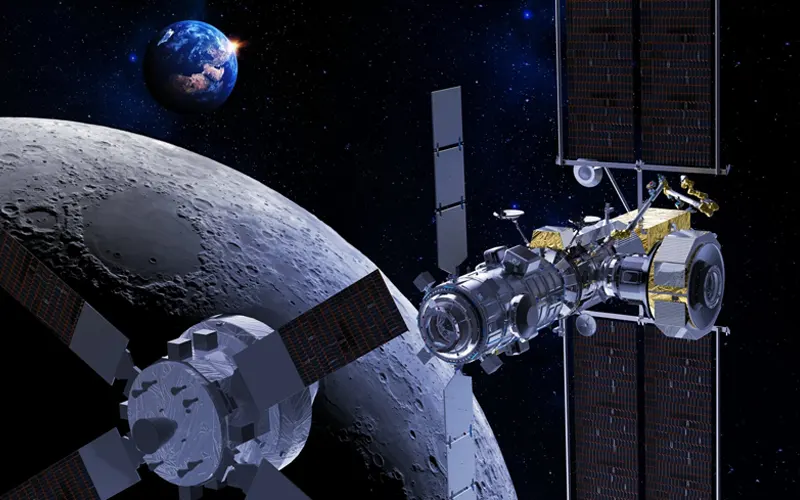
The European Space Agency (ESA) has made initial decisions on the future of its contributions to NASA’s Gateway space station after the US space agency “paused” the programme. The agency largely expects to proceed with developing most of its planned Gateway hardware while awaiting the results of studies on how best to repurpose each element.
In late March, during NASA’s Ignition event, the agency announced a revised Artemis architecture under which it would pause development of Gateway in favour of first establishing a base on the Moon’s surface. This decision meant that ESA’s planned contributions to the station no longer had a clear role within the programme.
ESA committed to providing three primary contributions to Gateway: the Lunar I-Hab habitation module, the Lunar View logistics and refuelling module, and the Lunar Link communications system. During a press briefing following the conclusion of the 347th ESA Council on 17 June, the agency outlined how it intends to proceed with each of the three elements.
Speaking to reporters, Daniel Neuenschwander, ESA’s director of human and robotic exploration, said work to develop I-Hab would continue until its critical design review, the last major design phase before full-scale manufacturing begins. The agency will then assess whether it can be repurposed.
On Lunar View, Neuenschwander explained that the agency would “slow down the pace of activities.” The agency intends to “keep the key technologies required in order to go towards deep space exploration.”
Finally, Neuenschwander said ESA was assessing whether Lunar Link could be used as a dedicated communications asset. He also suggested that it could potentially become part of the agency’s Moonlight programme, which aims to deploy a constellation of satellites around the Moon to provide communications and navigation services.
Although ESA’s planned Gateway contributions are likely to be reassigned to other missions, Director General Josef Aschbacher indicated during the same 17 June press briefing that he sees a continued role for the agency in the Artemis programme.
“These are discussions that are ongoing, I don’t want to pre-empt any of that, but I can only say that the spirit is very good, very strong,” Aschbacher said. “And yes, ESA wants to strengthen its own capability but also to be a very strong partner to NASA and to other space agencies, such as Canada, Japan, UAE and several others.”
Aschbacher’s remarks on 17 June were, however, more cautious than those he delivered eight days earlier at the Artemis III crew announcement.
“At ESA, we are ready as well. Our 23 Member States are aligning to step up in exploration. Because when you choose to be part of something as ambitious as Artemis, you contribute. That is what we do, what we will continue to do,” he said.
Greater clarity on ESA’s future role in Artemis could come in December, when ministers from ESA’s Member States gather in Italy for an interim Council meeting at ministerial level. Unlike a full Ministerial Council, at which Member States approve funding across ESA’s programmes, interim meetings generally focus on specific strategic issues. In this case, ministers are expected to “define the European exploration roadmap for the coming years.”



It is deplorable that ESA decides to waste even more taxpayer money on literally useless hardware. It was already unwise to want to use the I-Hab module operationally, given the corrosion damage it sustained during production. Coincidentally it was just revealed last week that the Americans have stopped all work on their HALO module. ESA would do well to take a cue from that.
What’s so surprising ? Exploration programmes have always been far more ‘job programmes’ than anything else.
The question is now if those ESA member states pushing for them have any idea how to divert financial and human resources to something potentially useful, but past experience shows that this is pure wishful thinking.