The Italian Space Agency (ASI) has enlisted students from the country’s Naval Academy aboard a tall ship to examine how the human body responds to the stresses of long-duration spaceflight as part of its ICE-Blue initiative.
In 2024, ASI signed an Operational Agreement with the Italian Navy, under which the ICE-BLUE initiative was launched in 2025. The decidedly tortured acronym stands for Isolation and Confinement Environment study in suBmariners and alliance crew as space anaLogues and microbial characterization of arctic sUb-surface Environments.
Coordinated by ASI and the Italian Institute of Technology (IIT), the first ICE-BLUE study was conducted in late 2025 aboard the Alliance, a NATO research vessel operated by the Italian Navy. The results of the study were expected to be compared with samples collected from astronauts on the Axiom-3 mission to the International Space Station, which included Italian Air Force officer Walter Villadei.
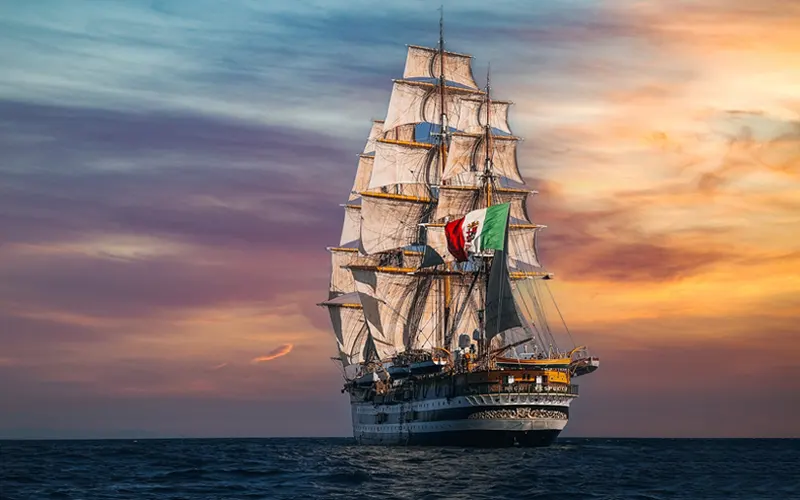
The second study began on 27 April 2026 with the collection of baseline samples from a group of students from the Livorno Naval Academy aboard the training vessel Amerigo Vespucci, a tall ship that was first launched in 1931 and is currently the oldest vessel still in service with the Italian Navy. The study is being undertaken during the vessel’s North American tour, which is expected to include 107 days at sea.
“The study will enable a better understanding of the body’s responses to prolonged operational conditions, disruptions to circadian rhythms, and complex mission environments, factors that NASA has identified among the key elements to monitor in order to safeguard the health and performance of astronauts involved in future space exploration missions,” said Barbara Negri, Head of Human Spaceflight and Experimentation at ASI. “It will also help identify potential countermeasures.”
According to a 19 May IIT press release, the study will involve doctors, biologists, pharmacologists, chemists, psychologists, bioengineers, and computer scientists, with the aim of collecting data useful for both space and military applications. Applications pertinent to crewed space missions are currently a key area of interest in Europe as the continent weighs whether to develop its own sovereign human spaceflight capability.
Europe currently relies on either private missions or flight opportunities secured through ESA’s barter arrangements with NASA to send astronauts to space, both of which make use of SpaceX Dragon spacecraft. In an 18 May opinion piece, ESA Director General Josef Aschbacher argued that Europe had become “too exposed to decisions beyond its control” and said autonomous human spaceflight was “not a luxury” but a necessary capability if Europe is to secure the scientific, economic, strategic, and geopolitical benefits of space. According to Aschbacher, the issue is expected to be discussed at ESA’s June Council meeting, which he identified as a key inflection point on the path towards more concrete programmatic decisions at the agency’s full Ministerial Council meeting in late 2028.
Italy is likely to have a significant stake in those discussions, having committed €834.7 million, or around 28% of all funding subscribed to ESA’s exploration programmes at the agency’s Ministerial Council meeting in November 2025. The country’s contribution was exceeded only by Germany’s, which accounted for 29.7% of the total.