
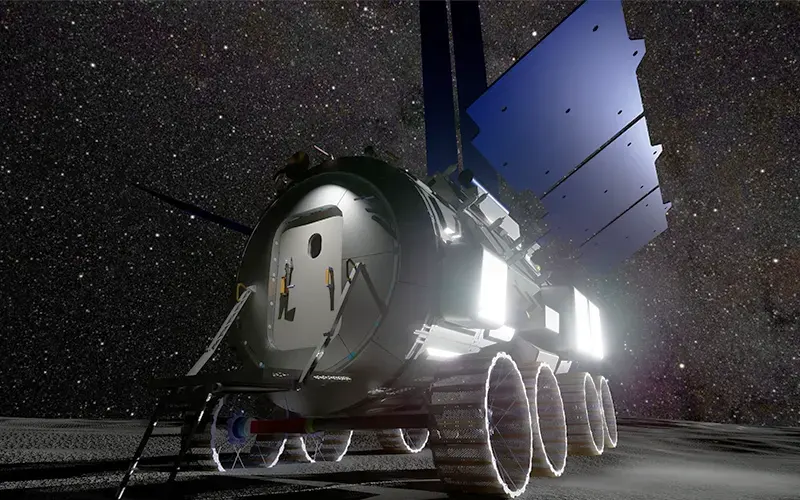
The Italian Space Agency announced on 22 May that its Multi-Purpose Habitation (MPH) module had been cleared by a NASA review board to progress toward a Preliminary Design Review in 2027. The first MPH module is expected to launch in 2033.
When NASA Administrator Jared Isaacman announced in March 2026 that the agency would “pause” the development of the lunar Gateway space station and shift its focus to building a base on the Moon’s surface, Italy’s MPH modules were identified as a key element of the initiative. Just days later, Italy and NASA signed a Statement of Intent to cooperate on the development of the US-led lunar surface base, including habitation modules, communications systems, and scientific activities on the lunar surface. According to the agreement, Italy would also secure at least one seat for an Italian astronaut on a future Artemis mission.
The MPH initiative was initially advanced by Italy’s space agency following the signing of a June 2022 bilateral cooperation agreement with NASA to conduct a preliminary design of the “Lunar Surface Multi-Purpose Habitation Module.” ASI later contracted Thales Alenia Space to lead its development.
On 19 May 2026, a NASA review board completed a combined System Definition Review (SDR) and System Requirements Review (SRR) for the MPH module’s design, clearing the project to proceed toward a Preliminary Design Review in 2027. In its 22 May press release announcing the successful milestone, ASI framed the programme in ambitious terms.
“This is a decisive milestone that brings us significantly closer to the ultimate goal: providing humanity with the fundamental technological infrastructure to live, work, and, finally, permanently inhabit the Moon.”
With the successful completion of the SDR and SRR, ASI and Thales Alenia Space can now prepare for the Preliminary Design Review (PDR), which will assess whether the module’s preliminary design is mature enough to meet NASA’s requirements before the programme advances into detailed design and hardware development. Preparations for the PDR are expected to take 12 months.