
Following the conclusion of the European Space Agency’s (ESA) Ministerial Council 2025 (CM25) meeting in Bremen, the budget for the agency’s Human and Robotic Exploration programme and the UK’s contribution to the agency have emerged as the most significantly reduced.
The agency initially announced a proposed three-year budget of €22.25 billion at the commencement of CM25. Following two days of discussions and multiple subscription rounds, Member States have agreed to total spending of €22.1 billion. This figure is up from €16.9 billion for the previous three years.
While many programmes saw oversubscriptions, the agency’s Human and Robotic Exploration budget, which ESA initially projected at €3.7 billion, experienced a significant undersubscription. ESA announced that Member States have committed just over €2.9 billion, a shortfall of more than 20%. The figure is, however, slightly higher than the previous three-year period, during which €2.7 billion in spending had been committed.
The responsibility for ESA’s Human and Robotic Exploration programme spans Low Earth Orbit operations, including ISS exploitation and astronaut training, lunar exploration activities such as the Argonaut lander, and Mars exploration missions, notably the Earth Return Orbiter within NASA’s Mars Sample Return campaign.
ESA has not yet confirmed which parts of its Human and Robotic Exploration programme have been unsubscribed. According to ESA Director General Josef Aschbacher, in cases of under- or oversubscription, the agency will revise its spending plan and then conduct discussions with Member States to determine the best path forward.
While Human and Robotic Exploration saw an undersubscription, Space Transportation recorded a dramatic oversubscription, rising from just under €3.9 billion to over €4.4 billion. This was largely driven by the oversubscribed European Launcher Challenge initiative, which Director General Aschbacher said had doubled its expected subscriptions, bringing in €900 million.
The European Launcher Challenge is focused on fostering the development of new commercial launch services. In July, the agency shortlisted Isar Aerospace, Rocket Factory Augsburg, PLD Space, MaiaSpace, and Orbex to proceed to the next phase of the European Launcher Challenge, which will be funded through the CM25 subscriptions.
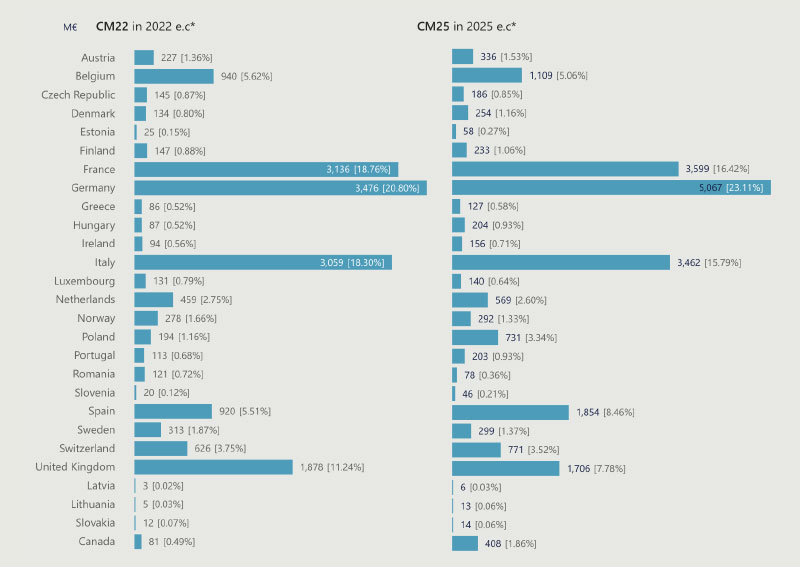
In addition to the Human and Robotic Exploration programme, the United Kingdom’s spending on ESA programmes saw a notable reduction, with the country now the fifth largest contributor, falling behind Spain, which recorded a substantial increase in its spending. While the United Kingdom’s total spending was reduced by just €172 million, from €1.878 billion to €1.706 billion, its contribution as a percentage of the total budget fell from 11.2% to 7.7%, the largest decline of any country by a considerable margin.
In addition to Spain, there were significant funding increases from Poland, Canada (an ESA Cooperating State), Denmark, and Austria. Germany’s contribution to ESA programmes rose sharply from €3.47 billion to just over €5 billion, with the country now accounting for 23.11% of all contributions to the agency.