
The European Space Agency expects to make specific safety adaptations to the Ariane 6 rocket for future launches of its Argonaut lunar landers that will carry a Radioisotope Power System. The modifications will not, however, be required for the spacecraft’s first mission.
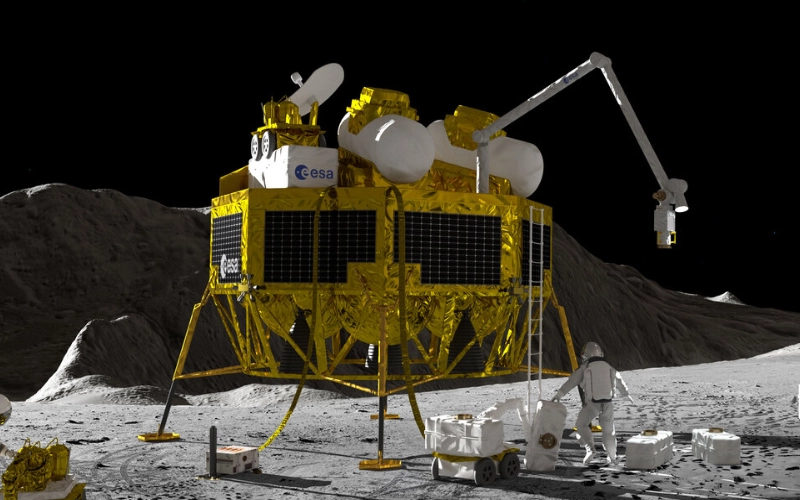
Argonaut is ESA’s planned heavy lunar lander that is designed to deliver up to 1,500 kilograms of cargo to the surface of the Moon. In emailed responses to questions from European Spaceflight, an ESA spokesperson confirmed that the Ariane 64 Block 2 is currently the baseline configuration for Argonaut missions, with some specific adaptations required for future missions carrying nuclear power systems.
“The current baseline for Argonaut is Ariane 64 Block 2, which features the P160C boosters and the Vulcain Aft Bay evolution,” an ESA spokesperson explained. “Specific adaptations will be required for the Argonaut missions carrying a Radioisotopic Power System.”
When asked about the adaptations, the spokesperson explained that they “relate to specific safety measures required for launching payloads with radioisotopic power systems.” The spokesperson added that these adaptations will not be necessary for the lunar lander’s first mission, as they “will not carry radioisotope power systems.”
ESA is currently developing European radioisotope heating and power systems through its ENDURE programme. An initial demonstration flight of the technology is planned for 2028 aboard the agency’s Rosalind Franklin mission to Mars, with a European-developed americium-241 radioisotope heating unit expected to be used aboard the mission’s lander.
Beyond the adaptations required for later radioisotope-powered missions, the use of Ariane 6 Block 2 as the baseline represents a shift in the underlying performance requirements for launching Argonaut. The agency had previously expected the lander to require the now-shelved, more capable Ariane 6 Block 3 configuration. According to the spokesperson, a joint task force working from 2023 to 2024 assessed the lander’s launch requirements at a time when ESA’s Human and Robotic Exploration directorate was targeting a higher performance level that would have required the upgraded Ariane 6 variant. However, subsequent system-level assessments have enabled ESA to reduce that requirement, with the latest mission definition now considered compatible with Ariane 64 Block 2.
In addition to the Ariane 6 Block 3, teams also assessed a two-launch architecture that would have launched Argonaut with its payload and a small amount of fuel aboard one rocket, and its full fuel complement aboard another. The two would then dock in orbit to refuel the lander before its journey to the Moon. With flight data from its first half-dozen flights supporting higher performance estimates for Ariane 6, a two-launch approach is no longer under consideration.
“Flight data analysis of the Ariane 6 launches already performed allowed us to significantly increase the achievable performance of Ariane 6. Ariane 64 Block 2 performance will be compliant with the Argonaut mission as currently designed. A two-launch architecture is not considered.”
While the spokesperson said the agency’s conclusion that Ariane 64 Block 2 would be sufficient to launch Argonaut was “firm,” they added that the mission baseline could still evolve and, as a result, “uncertainties will always remain.”
The first Argonaut mission is currently targeted for launch in 2030 aboard an Ariane 64. The mission is expected to include two technology demonstrators. The first will explore the landing area and test technologies, including systems that will enable it to survive the lunar night. The second is designed to demonstrate robotic technologies using the lander itself for future European lunar missions.


This is very exciting, as RTGs are the reason for success of some of the most significant Landers and craft since the 70s!! Viking, Voyager…