
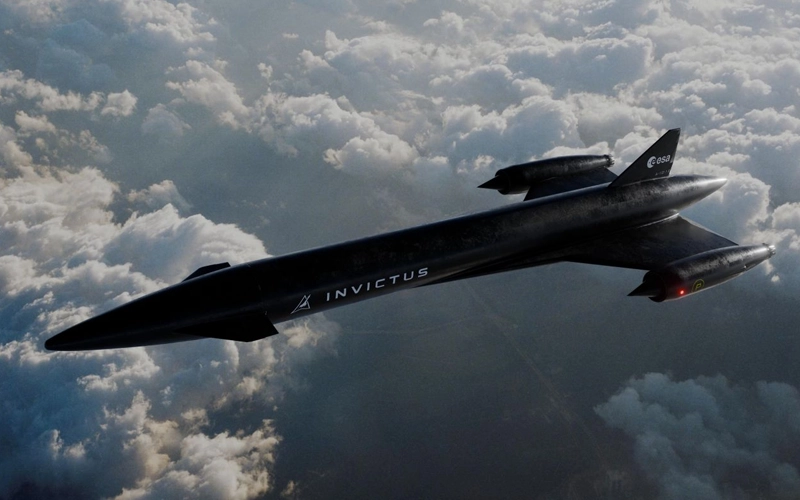
The European Space Agency’s (ESA) INVICTUS hypersonic aircraft programme has cleared its first major requirements review and moved into the next phase of development, with a second review expected in October 2027.
Stephan Carroll, INVICTUS chief engineer at Frazer-Nash, confirmed on LinkedIn on 23 October that the programme had successfully completed its first System Requirements Review (SRR-1) in March 2026. According to Carroll, the company held back on announcing the milestone “while subsequent programme planning activities were agreed with ESA and UKSA.”
“With the next phase Kick-Off, the programme is on track towards SRR-2, currently planned for October 2027,” Carroll wrote.
According to Carroll, work on the aircraft’s design has progressed across several areas, including aerodynamics, propulsion, pre-cooling, systems engineering, safety, certification and cost modelling.
Frazer-Nash was awarded a €7 million ESA contract in July 2025 to conduct the initial design work for the INVICTUS programme. Through the programme, ESA aims to develop a reusable hypersonic test aircraft capable of reaching Mach 5.
In its original procurement documents, ESA envisaged a Mach 5 flight by 2028. However, when Frazer-Nash formally announced the programme in July 2025, the company was targeting the first flight of a Mach 5-capable aircraft in early 2031. In June 2026, ESA’s INVICTUS technical lead, David Perigo, indicated that the programme was expected to be well into integrated propulsion testing by around 2032, suggesting that the aircraft’s first flight may have been pushed back by at least a year, potentially longer.

Is this Europe trying to catch up with Cold War technology? On the Esa website they don’t seem to be shy to point out they’ll copy key features of the SR-71, e.g. the “Sabre-like engines”. Furthermore it seems unclear whether it will be a defense vehicle, a test platform or a stepstone on a roadmap towards spaceplanes. Next issue: Timelines are typically Esa – the original in the sixties, A-12 Oxcart reaching Mach 3 took 20 months to develop and build. It’s kind of cute how officials are now leaning in, in an ambitious gesture, promising “Mach 5” to make it sound like it’s more than the Blackbird that’s been developed ~70 years ago. I expect the Mach 5 – requirement to be watered down significantly, maybe already in SRR-2. Speaking of SRR-2: Next thing that possibly dooms this project to be dead on arrival is that this is done by ESA themselves and a consultancy. Chances for this to ever go into hardware are slim I presume.
Huge waste of money. Hurts me to pay taxes for this.
I might be naïve but I think this is a cool project with huge, strategic potential.. And it could help ESA to become competitive and cost efficient again. ESA has always made brilliant things with relatively little money, particularly when it comes to launchers. The international system it is based on is often slow, inefficient and opaque but gives it deeper pockets and higher resilence than any single member State would ever have.
I understand that a lot of people do not whant it to succeed, because this technology could outperform existing business and harm them. I think that’s why ReactionnEngines was not rescued. Also, this program has a lot of value for the UK and even the US (US capitals are all over it) but not much for the rest of Europe at this stage. This must change if it is to succeed. So we should be aware of all of this and keep an eye on the program and our pressure on the decision makers to keep supporting it until it turns into reality.