
The European Space Agency has provided additional detail in response to claims made by NASA Administrator Jared Isaacman regarding the condition of Gateway space station modules already delivered to the agency, offering a clearer picture of the state of these key elements and the potential impact on the programme’s schedule.
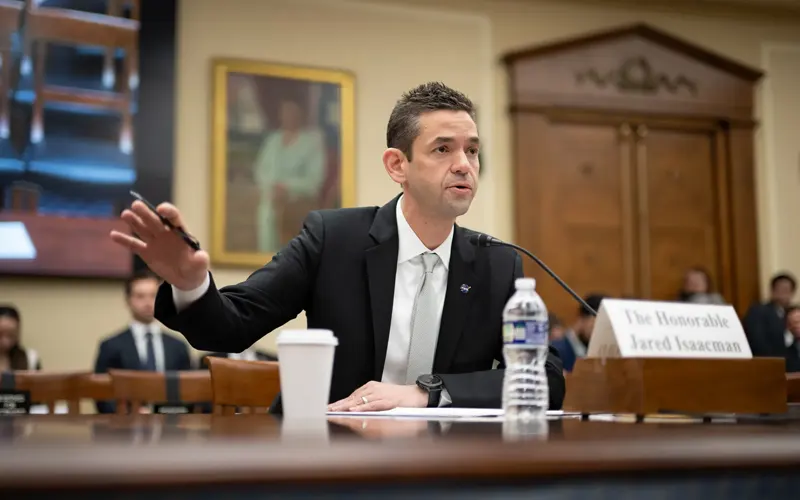
During a hearing before the US House Science Committee on 22 April, Administrator Isaacman testified on the status of elements of NASA’s Gateway space station, stating, “The only two habitable volumes that were delivered both were corroded.” He added that this issue would have delayed the programme “beyond 2030.” While Isaacman did not specify which modules he was referring to, commentary surrounding the Administrator’s testimony suggested he was referring to the Habitation and Logistics Outpost (HALO) and the International Habitation Module (I-HAB).
While HALO was part of NASA’s contribution to the station, with its construction led by Northrop Grumman, its primary structure was manufactured in Italy by Thales Alenia Space. The company has several decades of experience producing pressurised structures, including the Columbus laboratory and Harmony module of the International Space Station, as well as pressurised cargo modules for the Cygnus spacecraft.
The I-HAB module forms part of ESA’s contribution to the station, with JAXA providing key life support and environmental control systems. In October 2020, the European Space Agency awarded Thales Alenia Space the contract to develop and manufacture the Lunar I-HAB module.
In response to questions from European Spaceflight, ESA confirmed that the HALO module, which had been delivered to Northrop Grumman in April 2025 for final outfitting before being handed over to NASA, had arrived with signs of corrosion. While the agency confirmed that I-HAB had a similar but less severe issue, it clarified that the module had not yet been shipped to NASA.
“Following the identification of corrosion on HALO, a comprehensive investigation was promptly initiated,” explained an ESA spokesperson. “Preliminary findings indicate that the issue likely results from a combination of factors, including aspects of the forging process, surface treatment, and material properties. A dedicated tiger team was established for I-Hab under the guidance of ESA to solve this issue. Based on the investigation and available data, the corrosion issue was understood to be technically manageable and did not constitute a showstopper for I-Hab, which was, in any case, in better condition than HALO from a corrosion point of view.”
In addition to clarifying the status of the HALO and I-HAB modules, the agency said these elements were far from the only factors contributing to delays in the station’s development.
“Based on programme information shared by NASA, other elements provided by the US supply chain, such as the life support system and the thermal control pump, were also experiencing notable delays and technical complexity,” the ESA spokesperson said.
In its response, Thales Alenia Space explained that repairs to both modules were ongoing.
“Our teams are working hand in hand with our longstanding customer Northrop Grumman to ensure that the HALO module fully meets the mission’s requirements, using NASA-approved processes,” a spokesperson for the company said. “A well-known metallurgical behavior was found at the surface of the module, which will be fixed by the end of the third quarter of 2026. As for Lunar I-HAB, which is still in our facilities to date, we are also teaming up with ESA to fix soon the same related issue.”
The company also explained that the issue was not unfamiliar to the company, with a similar “metallurgical behavior” having affected modules of the International Space Station.
“Our company, together with its customers and partners, is used to [facing] and [solving these kinds] of situations, in this very challenging space environment. As an example, a metallurgical behavior of this kind occurred decades ago during the manufacturing of elements for the International Space Station (ISS). The ISS’ pressurized modules have proved to be highly performant, and continue to operate reliably, exceeding their original expected lifespan. With nearly 50% of the ISS’ pressurized volume built by our company still functioning after 25 years, we leverage this experience to address the current situation with agility, expertise and full technical control.”
In his testimony, Administrator Jared Isaacman said that NASA was exploring the potential repurposing of Gateway elements for the agency’s planned surface base. It remains unclear whether this includes HALO and I-HAB, and whether efforts to restore these elements of the station will continue.
Update: This article was updated on 27 April to include the statement from Thales Alenia Space.



Well that is an F-up. I used to argue that the Gateway cancelation should not have to affect us as ESA was acting as ‘fixed-barter’ subcontractor and should still claim its flights if they delivered. (Just as Canada got its Artemis flight.) But now NASA can just terminate them for non-compliance, and ESA has no leg to stand on.
And according to Eric Berger, the Axiom module is affected too. (No news on Cygnus yet)
Given all the experience at Thales, how is this possible?
Did they change the production process?
If so why, and why did they not test it with a mockup module first?
If not, why are previous modules not affected? Or are they affected too, but nobody registered it?
> which had been delivered to Northrop Grumman in April 2025 for final outfitting before being handed over to NASA,
If these are ESA contributions, why is NG involved? Are they paid by ESA or NASA? Is this NG USA or a European subdivision?
>In addition to clarifying the status of the HALO and I-HAB modules, the agency said these elements were far from the only factors contributing to delays in the station’s development.
Ok so they were behind *on everything else* too? How is this supposed to make anything better? How are we supposed to be taken as a serious partner after this?
ESA wants/needs NASAs help for its Mars mission, but it is handing Trump excuses to bail on a golden platter.
>other elements provided by the US supply chain, such as the life support system and the thermal control pump, were also experiencing notable delays and technical complexity,” the ESA spokesperson said.
Should that not be *to* the US supply chain?
The article mentions that the life support (and implies the pump) is provided by JAXA.
I know the mission of EuropeanSpaceFlight is to promote the European space industry. Having to report on disasters like this must make you want to cry. (I know I want to – I settled on ranting for now)
In terms of the other elements cited by the ESA spokesperson, they are provided by the US supply chain and not “to” the US supply chain as you suggest. These are elements that NASA was responsible for and that are now delayed. And JAXA was providing the life support system for I-HAB, not the whole station.
Also, ESA is not behind on anything. I-HAB was scheduled to be delivered to NASA this year, but there would not have been much point since NASA is so far behind on SLS and Orion. Also, ESA has delivered the ESMs promptly and completely up to spec. As far as NASA should be concerned, ESA has been a model partner in its contributions to Artemis.
It is also clear that the corrosion issue was being addressed and, as ESA stated, was not expected to delay the programme any further than it already had been.
In our opinion, NASA Administrator Isaacman was well out of line throwing Europe under the bus here, especially given the many issues his agency has had with its own Artemis elements (the Orion heat shield comes to mind). If this is an issue he felt needed to be addressed, he should have done so in an appropriate forum.
You are right about ESA, in my frustration I’d forgotten for a moment that the HALO module was ordered directly by NorthropGrumman.
But Thales had enough time to come clean on the corrosion its own (Unless restricted from doing so by NG or another customer?)
Does not take away that the module is already years late despite even before this issue, although enough blame for that can be shared with NASA’s late order, Doug Loverro’s changes and NG’s issues with fixed price contracts.
Isaacman was in his right to speak of corrosion (regardless of the motive), but should have mentioned the other issues too.
As to the I-HAB, unless it is already being outfitted, it would probably be late too, but not a showstopper even in the new Artemis schedule. Although having I-HAB ready before the HALO would be funny, if useless.
Hopefully ESA can find a new use for it – perhaps as module on a commercial station, or a station partnership with India? (Building propulsion should not be the hardest part, as NASA’s PPE is based on a Maxar GEOsat bus)
So I was mistaken blaming ESA here, indeed except for the first service module they seem to be on time with them.
Speaking of SLS, I was a bit disappointed that ESA did not get to build the new Second Stage.
The Ariane6 upper stage seems to be of similar power and size as the Centaur5 they will be using. And as you know the Vinci engine was offered for SLS before.
The combination of ESM and 2nd stage could have been interesting, and perhaps the basis of a re-fuellable space tug.
> In our opinion, NASA Administrator Isaacman was well out of line throwing Europe under the bus here, especially given the many issues his agency has had with its own Artemis elements (the Orion heat shield comes to mind). If this is an issue he felt needed to be addressed, he should have done so in an appropriate forum.
Basically, he should have kept the failure quiet and hidden to maintain appearances.
Sorry but the option of managed decline is off the table with NASA. When you fail, it will be out in the open for everyone to see. You don’t get to fail the expense of the taxpayer and expect for there to not be consequences. Or if you do, it won’t be as a contributor to any project that NASA is involved with.
That’s not what I said. This is obviously something that should be addressed. It should, however, have been addressed with the ESA Director General by his side in a joint press conference. That’s what partners do.
Isaacman is a straight shooter. He wouldn’t make such a claim unless it was true and problematic
Hey there just wanted to give you a brief heads up and let you
know a few of the images aren’t loading correctly.
I’m not sure why but I think its a linking issue. I’ve tried it in two different internet browsers and both show
the same results.