
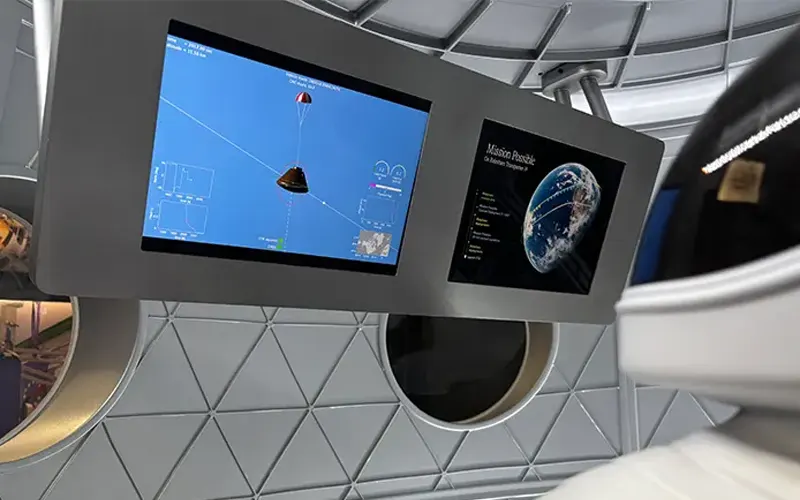
The Exploration Company has announced the establishment of a US-based entity, TEC Federal, which it will use to compete for US government contracts. The company will conduct its US operations from its new Rapid Innovation Lab in Houston, Texas.
Founded as a Franco-German space transportation company in 2021, The Exploration Company is developing a reusable space capsule called Nyx that will initially be used to carry cargo. The company has also proposed a crewed variant of the capsule. While this was initially presented as a longer-term project, comments made by the company’s CEO during the official opening of its new Houston facility suggest that its development timeline may have been accelerated.
“Houston gives us direct access to the people and expertise that have built and operated human spaceflight systems for decades,” said the company’s chief executive Hélène Huby. “We’re excited to invest and expand around that — engineers, operators, and astronauts working together and moving quickly towards building a crew capsule.”
The establishment of the US-based entity and the opening of its Rapid Innovation Lab point to a growing focus on the US market. Recruitment notices for personnel to work on a crewed capsule further suggest that the company sees greater demand for such a vehicle in the United States than in Europe. This is perhaps unsurprising given the scale of the US market. NASA’s FY2026 budget includes approximately $1.3 billion for its Commercial Crew Program, through which the agency purchases astronaut transportation services from SpaceX. That single budget line, covering exactly the kind of service the Nyx Crew capsule would provide, is larger than ESA’s €818.4 million budget for all of its human and robotic exploration programmes for 2026.
While ESA’s Director General Josef Aschbacher said in an op-ed in May that autonomous human spaceflight was no longer a luxury but a necessary component of Europe’s future space programme, member states have not committed to that vision.
Ahead of ESA’s Ministerial Council meeting in November 2025, known as CM25, the agency set an ambitious €3.7 billion target for its Human and Robotic Exploration programme, €1 billion more than the €2.7 billion committed for the previous three-year period. However, member states ultimately committed just over €2.9 billion at CM25, leaving the programme more than 20% short of its target.


While I understand their decision, as a European this really saddens me. TEC was our hope to finally get crewed spaceflight in europe, but while this will maybe give us easier acces, it is still developed in the us. I really hope they will still have a large part of their company in europe, like nyx cargo, nyx moon and their upcoming launcher, and not just move entirely to the us. Afaik this was the only crew capsule actively in development(I count the cargo varient as development) in europe.