
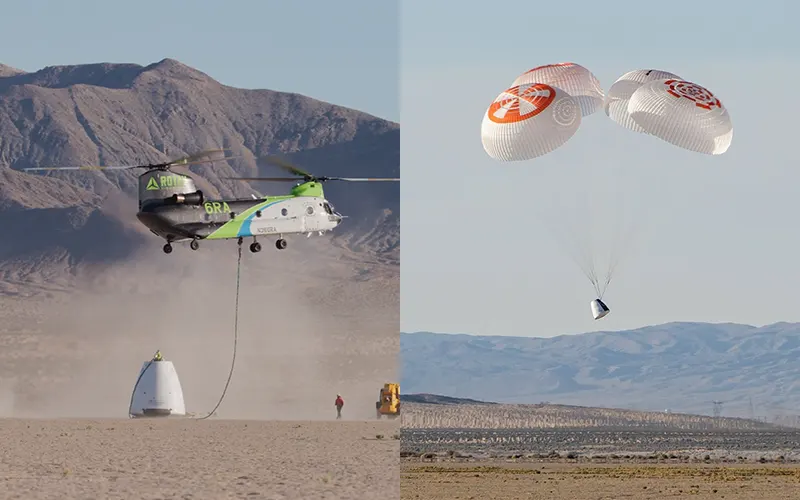
The Exploration Company has completed a key milestone in the development of its Nyx spacecraft after successfully conducting a drop test designed to validate the performance of its recovery system.
Nyx is designed as a reusable space capsule that will be used to transport cargo and, potentially, crew to low Earth orbit. The company is currently working toward an initial demonstration of Nyx in 2028 with support from the European Space Agency through its LEO Cargo Return Service initiative.
On 4 June, The Exploration Company announced that it had completed an initial drop test designed to assess the performance of the space capsule’s recovery system. The company used a dedicated Drop Test Vehicle designed to mimic its mass and aerodynamic profile. The parachute system used for the test was provided by US-based Airborne Systems, which has supplied or supported the development of parachute and recovery systems for Boeing Starliner, NASA’s Orion, SpaceX Dragon, and Blue Origin’s New Shepard capsules.
While designed for splashdown recoveries, the test was conducted in the Mojave Desert, with the company explaining that the location simplified the logistics of the test and facilitated faster recovery of the test article following its completion. The adjustment did, however, require the company to include “sacrificial outer panels to support ground impact,” enabling it to recover the rest of the hardware in a state fit for future test campaigns.
During the test, a Boeing CH-47D Chinook operated by Alaska-based Rotak Helicopter Services lifted the Drop Test Vehicle to an altitude of 2.8 kilometres before releasing it. Rather than being deployed by the vehicle itself, the drogue parachutes were extracted using a static line, stabilising the vehicle ahead of main parachute deployment. All four main parachutes were deployed successfully, allowing the vehicle to touch down as gently as a system designed for splashdowns could reasonably achieve.
According to a 4 June press release, early analysis indicates that the recovery system performed as expected.
“Initial analysis confirms that the required conditions and event timings were achieved, including nominal extraction and handover from the drogues to the main parachutes,” said the company. “The vehicle dynamics observed during initial release and handover were in line with expectations for this DTV configuration, including its mass and inertia range.
The company will now move forward with additional subsystem testing, including motor firings, cutter tests, and space qualification activities to demonstrate that the recovery system can deploy, separate, and survive flight conditions.


So will ESA country have an independent access to reentry tech with the USA providing the parachute and the platform and location for critical tests?
I bet Airborne Systems doesn’t want the tech to leave the US…
I’ll ask.