
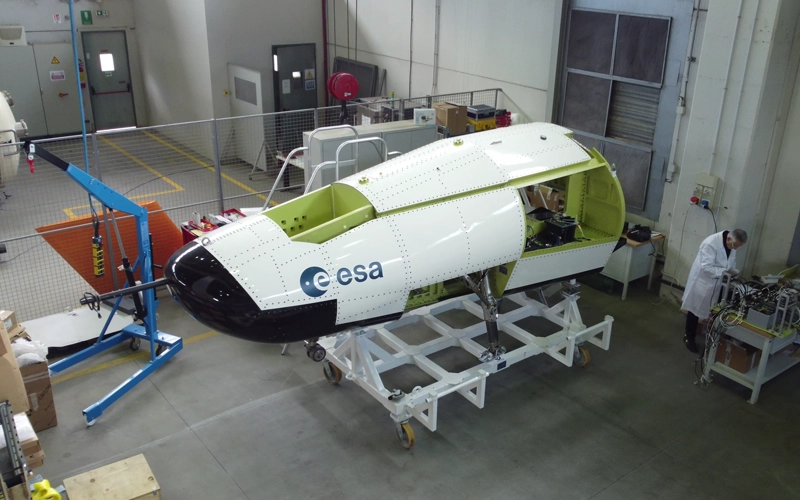
A full-scale drop test of the European Space Agency’s Space Rider spaceplane ended abruptly after the test model’s parafoil failed to deploy as expected. This marks the second time this year that a Space Rider drop test has been interrupted by an anomaly, following an aborted attempt in May.
The incident occurred during the vehicle’s final system-level drop-test campaign, conducted earlier this month. According to ESA, an anomaly occurred during the deployment of the test model’s parafoil, which would have allowed it to glide safely to the designated landing area.
“The test model was lost as a result of the anomaly,” an ESA spokesperson told European Spaceflight. “An independent investigation is ongoing to determine its root cause and inform the next steps.”
This marks the second setback for Space Rider’s final system-level drop-test campaign this year.
As European Spaceflight reported in June, an earlier test attempt in May was aborted following an anomaly during the captive ascent phase, when a CH-47 Chinook helicopter carried the test model to altitude.
At the time, ESA confirmed that the test vehicle had been recovered safely. However, the agency explained that testing would not resume before October, primarily due to the availability of the test range.
Earlier drop tests in 2024 and 2025 used mass simulators to test Space Rider’s parafoil and autonomous landing systems. The final system-level drop-test campaign used a full-scale model that replicated the spacecraft’s mass, aerodynamic shape and landing gear, allowing ESA to validate its landing performance under more representative conditions.
ESA has not said whether it will need a replacement test model or when another test attempt could take place.
Despite the failed drop test and the loss of the test model, ESA still expects Space Rider’s inaugural flight to take place in 2028. However, the target has shifted slightly from the first quarter of the year to the second.
Space Rider will be launched aboard a Vega C rocket equipped with the upgraded P160C first stage from the Guiana Space Centre. The mission is expected to be the first flight of the rocket to use the more powerful solid-fuel booster.
Updated on 20 Oct: A previous version of this article incorrectly described the incident as the second failed drop test this year. The earlier attempt in May was aborted rather than failed.



Brings back memories of ESA’s Mars landing demonstrator “Shrapnelli”. The demonstrator seems to be an unpropelled glider – landing that is basically a student project. All this while US and Chinese entities do retro-propulsive landing like it’s nothing. I wonder at what point ESA realizes their failures are systemic.
I was thinking about the Exomars landing tests following Shrapnelli. Apparently ESA has a problem here, and they either do not have the technology in-house, or no budget. I wonder why, are they using a special system for space flight, or did they stumble on a issue that can help the whole parachute and parasail communities if they solve it – maybe even save lives?
Or perhaps the interruption just caused a human mistake during the set-up of the test.
What I find equally troubling is that they ran out of test range availability *again*, suggesting they do not plan for finding issues, making it more demonstration then test flights.
Back then they had to beg NASA for assistance and did a few drop tests in the USA.
Around that same period, SpaceX had issues with the parachutes for its Crew capsule, and did 22 drop tests. Moreover, they found issues with the parachute modelling software itself rather then the parachutes. Which makes me wonder, is ESA still using outdated models of parachute/-foil deployment?
The US and soviet space shuttles were unpropelled gliders that worked very well. The Challanger and Columbia disasters and the demise of the Buran were not related to them gliding on their way back. And the US and China still have spaceplanes that use the concept and if I look at Starship I see hints of gliding in the upper atmosphere. Europe is developping vertically landing reusable stages but reentry can be achieved by more than one way. Failures happen when you innovate, especially when you are not having the funds you deserve. But European space is moving up (litteraly), and that’s good.
Within our thick atmosphere, a winged recovery is demonstrably better than the retro-propulsion flying circus; this is common sense and basic physics. However, the mass penalty associated with increasing the gliding ability of this ‘Minion’-shaped craft has been squandered on a parafoil, and they don’t always deploy properly as any parachutist will tell you. A missed opportunity to re-do the old French Hermes properly.
So to be clear “lost” means just crashed or crashed with no wreckage (because it sunk for example)?
If I remember right the test campaign was over land so probably the former.
And ig there go some hopes of having domestic recoverable space experiments soon.
i am once again astonished by how this failure is being communicated. At some point, ESA needs to be told in no uncertain terms that they are operating on the EUs taxpayers expense and that we are expecting transparency and openness in what they are doing.
@Thomas
> ESA needs to be told in no uncertain terms that they are operating on the EUs taxpayers expense
The ESA is not part of the EU. For example, Switzerland and the UK are members.
@Jon: it is true that there are non-EU member States of ESA and that most financing comes from national budgets but a small contribution also comes from the EU budget.
@Jon i agree that i should not have used EU here. i was not referring to the institution but to the people living in the ESA member states which overlap significantly with the EU but i see your point and should have been more precise