
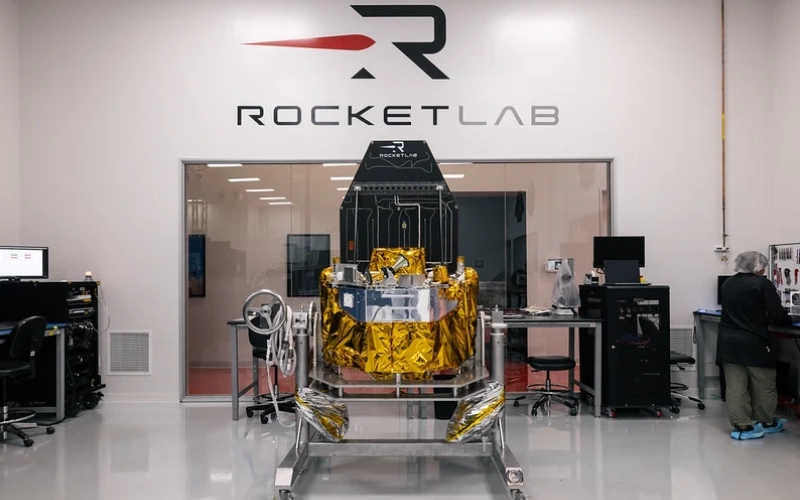
Rocket Lab has established a new subsidiary in Germany to enable it to offer scaled domestic production of satellites and launch services on both its Electron and Neutron rockets.
The company formally announced Rocket Lab Germany GmbH on 10 August, calling it a “milestone in the company’s international growth.” The actual establishment of the subsidiary, however, predates Monday’s announcement by several months.
According to German company records, Rocket Lab Germany GmbH was created from a pre-existing shelf company, Mondstein 694 GmbH. Its shareholders approved the change of name and business purpose on 27 March, with the change reflected on 2 April, shortly before Rocket Lab completed its acquisition of the Munich-based optical communications terminal supplier Mynaric AG. While records show that Rocket Lab Germany is based in Munich, its registered address appears to be a serviced-office location rather than a dedicated Rocket Lab facility.
During its 10 August earnings call, Rocket Lab outlined three main pillars of its strategy for Rocket Lab Germany: satellite manufacturing, assured access to space, and strategic autonomy and space sovereignty. Rocket Lab CEO Peter Beck highlighted satellite manufacturing as a central part of the company’s planned European expansion during the question-and-answer portion of the call.
“There’s a real opportunity here for us to establish a regional hub for constellation-class manufacturing as well as full-scale spacecraft assembly, integration, and test,” Beck said. “This will enable Rocket Lab to serve commercial, civil, and defense space programs as a domestic European provider”
Beck also hinted at a clear driver behind the company’s decision to establish a presence in Germany and why satellite manufacturing would be a key focus.
“Europe is a really interesting market. It’s typically been extremely sheltered, but with the recent geopolitical tensions, all of the European nations are looking for sovereignty,” Beck said. “A good example more recently is Germany has put over $40 billion into a satellite missile warning system, along with other things, and typically that would have been outsourced to other nations.”
Beck appeared to be referring to Germany’s commitment to invest €35 billion (roughly $40 billion) in space-related defence projects by 2030. The spending is expected to fund several capabilities, including satellite communications, reconnaissance, missile early warning, and improved access to space.
Launch was another area Beck highlighted in his comments, suggesting that Europe’s limited launch capacity could create an opening for the company.
“On launch itself, we’ll see,” Beck said. “Clearly Europe really only has a couple of launch vehicles that are launching relatively infrequently, and if you’re trying to build whole constellations of systems, then you might need some help with launches also.”
It is, however, unclear how much additional capacity Rocket Lab could realistically offer, at least initially. In 2025, the company launched 21 missions aboard its small Electron rocket. With a maximum payload capacity of 300 kilograms to low Earth orbit, those 21 missions would have provided a theoretical maximum annual upmass of 6,300 kilograms. For comparison, the most recent flight of the upgraded four-booster Ariane 6 launched 36 Amazon Leo satellites, carrying more than 20 tonnes to orbit on a single mission.
While Neutron will be significantly more capable, with a planned payload capacity of up to 15,000 kilograms to low Earth orbit, its availability will initially be limited.
During the 10 August earnings call, Beck reiterated that Rocket Lab is planning around an initial “1-3-5 cadence” for Neutron, although he said the company hoped to exceed those numbers. He also explained that the company has sold several Neutron flights to both commercial customers and the US government. The next available flights may, as a result, be in 2030. This availability could, however, come at a fortuitous time.
In an interview with the Financial Times published on 10 August, ESA Director General Josef Aschbacher warned that Europe was heading towards a shortage of launch capacity around 2030.
“If we add up all the satellites that need to be launched from current and planned constellations and missions . . . we see that there’s a peak of launch requirements around 2029, 2030, 2031,” he said.
Aschbacher did, however, add that Europe was working to bridge that gap, examining ways to increase the annual launch cadence of Ariane 6 from around 10 to 15, or even 20, flights a year. A similar increase in Vega C launches is planned, as the Italian launch provider prepares to introduce Vega E before the end of the decade.



We have a growing demand within Europe for launch and satellite manufacturing that will provide a rare level of commercial opportunity for the selected suppliers. I don’t think letting Rocket Lab directly tap into that through a German shell is a beneficial long term solution for durable scaling of Europe’s launch and satellite manufacturing capabilities. Having a German subsidiary does not make Rocket Lab’s decision centers align with European interests, it just lets them secure the contracts before the up and coming truly European players get a chance at commercial operations.
If there aren’t commercially available solutions with this maturity for launch and constellation build, the options are outside the continent or the missions don’t occur. Here you have the potential for the hiring and the manufacturing to be local and the economic benefits of that