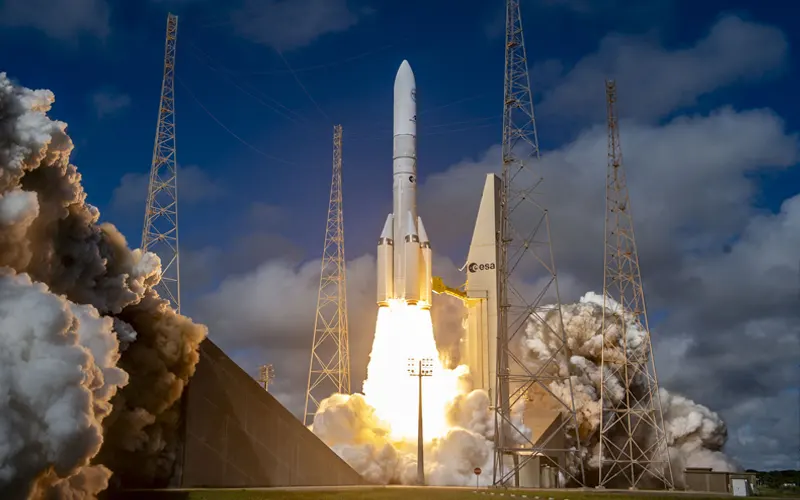
Arianespace has successfully completed its third Ariane 6 flight of 2026, delivering another 36 Amazon satellites to orbit aboard a new variant of the rocket that features the upgraded P160C solid-fuel boosters.
The Ariane 64 rocket, which features four solid-fuel boosters, lifted off at 12:21 UTC from ELA-4 at the Guiana Space Centre. The launch was delayed briefly due to an undisclosed issue with the launch range, forcing a hold call one minute before main engine ignition.
One hour and 26 minutes after liftoff, the first satellite was deployed into low Earth orbit. Less than half an hour later, all 36 satellites for Amazon’s Starlink competitor had been deployed. According to Arianespace, the payload was the heaviest ever launched by an Ariane rocket. While the company did not specify the payload’s total mass, an Amazon spokesperson later confirmed to European Spaceflight that it was 22 tonnes.
In order to carry the record payload, the rocket featured upgraded solid-fuel boosters. The P160C boosters are one metre longer than the P120C boosters used aboard all previous Ariane 6 flights and feature more than 14 tonnes of additional solid propellant. The result is a 10% to 15% increase in payload performance.
“Ariane 6 was designed from the outset to be a modular launcher. We have now seen it launch in three versions in just two years and we are not finished. Further evolutions are still to come,” said ESA Director General Josef Aschbacher.
In addition to upgrading the rocket’s performance, the European Space Agency is also examining the possibility of increasing the system’s maximum launch cadence. Speaking at a press briefing following ESA’s 347th Council meeting, Aschbacher explained that while the rocket’s nominal launch cadence was nine launches per year, studies were underway to raise that to 12, 15, or even 20 launches per year. He added, however, that each option came with different costs and implementation schedules, and that the agency was still examining whether there would be demand for the additional launch capacity.
The next Ariane 6 launch is expected on 28 August, carrying the MTG-I2 weather satellite for EUMETSAT aboard the two-booster variant of the rocket.
Update: This story was updated on 17 June to include the total mass of the payload launched by the upgraded Ariane 6 rocket.