
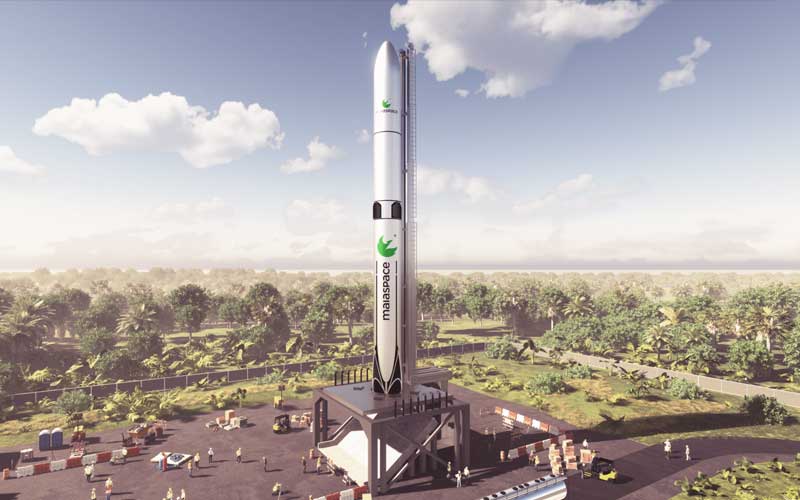
ArianeGroup has decided against dissolving MaiaSpace after the company posted a €37.5 million loss for 2025, pushing its shareholders’ equity below zero.
According to the company’s 2025 annual accounts, filed on 22 July 2026, MaiaSpace ended the year with €114.2 million in cash. Despite that seemingly healthy cash position, its shareholders’ equity fell from a positive €35.82 million at the end of 2024 to negative €823,375. Shareholders’ equity is what remains after the company has paid all its liabilities. A negative figure means it owes more than it owns.
“In view of the loss for the current financial year, which amounts to €37,513,586, our company’s shareholders’ equity stands at negative €823,375. Shareholders’ equity is less than half of the share capital. A decision will therefore need to be made on the continuation of the company’s operations,” the company said.
Under French corporate law, when shareholders’ equity falls below half of the company’s share capital, the shareholder, in this case ArianeGroup, is required to decide whether the company should be dissolved or allowed to continue operating. At a meeting on 25 June 2026, ArianeGroup officially rejected the option of dissolving MaiaSpace, allowing the company to continue preparations for the inaugural flight of Maia.
“The sole shareholder notes that, following the allocation of the loss, the company’s shareholders’ equity is less than half its share capital and, having considered the president’s report, decides, in accordance with Article L. 225-248 of the French Commercial Code, not to dissolve the company early,” states a sole-shareholder resolution dated 25 June 2026 and filed alongside MaiaSpace’s 2025 annual accounts.
According to its annual accounts, the company’s cash position fell by €62.46 million from 2024 to 2025, which is about €5.21 million per month. This figure, however, includes roughly €11 million invested in fixed assets. Excluding that investment, European Spaceflight estimates that MaiaSpace’s operational burn rate was approximately €4.3 million per month. At that rate, the company had around 26 months of runway at the end of 2025, which would take it to early 2028 if its spending remained unchanged and it received no additional funding or customer payments.
MaiaSpace is currently targeting the second half of 2027 for the inaugural orbital flight of Maia. The company recently abandoned an earlier plan to conduct a separate suborbital test flight, arguing that its programme of ground and combined testing had reduced the value of the additional flight. However, 2027 is also significant for its participation in ESA’s European Launcher Challenge.
During ESA’s Ministerial Council meeting in November 2025, a total of €184.9 million was committed to MaiaSpace under Component A, which covers launch services for ESA and other European institutional customers between 2026 and 2030.
According to the programme’s published timeline, companies are required to complete an initial successful orbital launch no later than the end of 2027. Earlier this year, MaiaSpace pushed its planned suborbital test flight to early 2027, months before scrapping it altogether, a schedule that would likely have created significant pressure to follow up with an orbital attempt before the end of that year.


interesting, but to be expected, when a company has yet to deliver on its promise, and does not have a Billionaire paying the bills. i am usually critical of ArianeGroup but it makes sense to continue funding Maiaspace so they can go flying without having to worry about finding investors. Having said that, ArianeGroups pockets are probably not bottomless so we’ll see how long the support will last….