
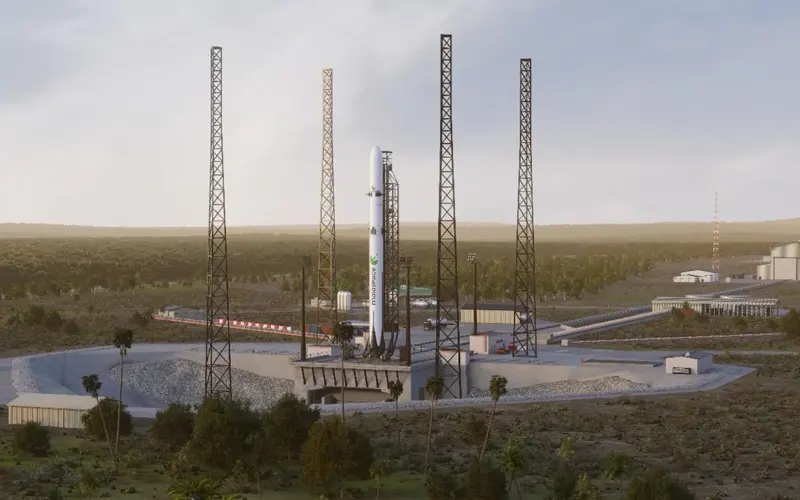
ArianeGroup subsidiary MaiaSpace is examining the possibility of doubling the performance of all variants of its Maia rocket “if market response for such a configuration is favorable.” According to the company, this upgrade would involve the addition of a fourth Prometheus rocket engine powering its first stage and would not increase the average cost per launch.
MaiaSpace is currently working toward an early 2027 debut of Maia. The two-stage rocket’s first and second stages are powered by Prometheus methalox engines developed by ArianeGroup under a European Space Agency contract for the Themis demonstrator.
During a Paris Air Forum event on 12 June, MaiaSpace CEO Yohan Leroy announced the company’s plan to upgrade the rocket with the goal of doubling its overall performance. Speaking to European Spaceflight, a spokesperson for the company explained that the upgrade was a planned “two-year development project that MaiaSpace will launch if market response for such a configuration is favorable, once it has demonstrated the three-engine version.”
With the addition of a fourth Prometheus engine powering the rocket’s first stage, Maia will, according to the spokesperson, be capable of delivering up to 8 tonnes to low Earth orbit “without increasing the cost per launch [on] average.”
The addition of a fourth Prometheus engine would, however, have a non-negligible effect on the cost of the rocket. In June 2024, ArianeGroup stated that one of the goals of the Prometheus programme was “to build future liquid propellant engines with a unit cost of about 1 million euros.” So, at the very least, it would add €1 million to the cost of building each Maia first stage.
In addition to doubling its top-end performance, the spokesperson explained that it would double the performance of all variants of the rocket, including its reusable configuration. Currently, the rocket is capable of delivering just 500 kilograms to low Earth orbit when its first stage is recovered.
Asked whether additional engines could further improve its performance, the spokesperson said that Maia could serve as a precursor to a future family of reusable launch vehicles. They did, however, stress that the company is currently focused on delivering the rocket in its current configuration.
“The Prometheus high and variable-thrust engine as well as stage recovery technologies are scalable and can be implemented on launchers of larger capacities for a fraction of the costs necessary to develop a new launch vehicle, allowing strong perspective of performance increase, depending on market evolution,” said the spokesperson. “In this way, Maia can be considered as a precursor of a future family of reusable, cost-effective and eco-designed European launchers. But it is important to understand that we are not in a techno-push mode. Our approach is to try and best answer to market demand.”


That is surprising that addition of a fourth engine brings the LEO payload to 8 tons. That’s close to the 10 tons of the first version of the Falcon 9. It would then no longer be a small launcher. It would be in the medium launcher range.
Keep in mind few launches of the F9 require its full 22 ton current capability. So this would mean already by Maias first launch in 2027 it would be competing with the F9 for the satellite launch market. That would be remarkable if true.
To put this payload increase in further perspective, the Apollo capsule only weighed 6 tons. This means already by 2027 Europe would have its own manned flight capable all-liquid launcher.
I’m aware there has been speculation of making the Ariane 6 a manned launcher. But the experience of the space shuttle has made regular manned flights using large SRB’s less than desirable, the SLS not withstanding.
Robert Clark
Whether they should do it seems like a dumb question with an obvious answer. It begs the question of why that wasn’t part of the original design? The claim that it wouldn’t increase launch cost may be taken as meaning “not by a lot”. Noting that Maia Space is a wholly owned subsidiary of ArianeGroup, the answer to both questions is probably that it would take the LV into competition with Ariane 6, rather than just Vega C.
From the competition angle:
– Would seem that Rocket Lab’s Neutron would be a direct competitor, in the new launcher space.
– the wild card is SpaceX. In the next year or so, Falcon 9- the most experienced, repeatable launcher on the planet- is going to lose as much as 60% of its payloads- the Starlink V2s- when Starship starts doing its primary job of launching full-sized Starlinks. (The kink for SpaceX tho is that it’ll be awhile before Starship can reach all orbits that Starlink needs). If Gwynne decides to Seriously use F9 to compete, they can keep any of the new F9-class competitors from becoming real players, because no one- not Maia and Rocket Lab, combined, even – could match their capability for frequent, reliable launcher to ALL orbital inclinations. If instead they don’t use the new F9 capacity to really compete, then the newbies would have a chance.