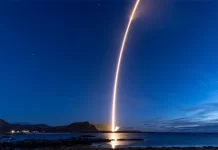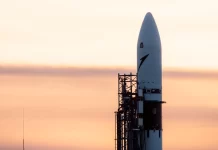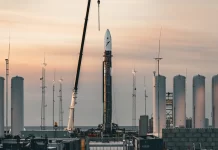

German launch startup Isar Aerospace announced on 9 June that it had closed a €270 million Series D to “drive global scaling and ramp up serial production.” With the announcement, the company stated that the months-delayed second flight of Spectrum was now expected to take place between 15 and 21 June.
Isar Aerospace is developing a two-stage rocket called Spectrum, designed to deliver payloads of up to 1,000 kilograms to low Earth orbit. The company launched its first Spectrum rocket in March 2025, with the flight ending in failure less than a minute after liftoff.
After returning to its launch facility in Norway before the end of last year, Isar Aerospace got within seconds of liftoff on 25 March 2026, with an unauthorised vessel entering the designated danger zone halting the launch. An attempt on 9 April was also scrubbed after the company discovered a leak in a composite overwrapped pressure vessel, which stores high-pressure gas to pressurize propellant tanks and actuate valves. Until this morning, the company had not shared any updates on a revised launch date for the flight.
On 9 June, the company announced the mission, dubbed Onward and Upward, would be launched between 15 and 21 June, carrying five CubeSats and one experiment.
While preparing for Spectrum’s second flight, Isar Aerospace is looking ahead to transitioning to operational flight cadences as efficiently as possible. According to the company, the €270 million in new Series D funding it has secured will support this transition.
The round saw participation from new investors Island Green Capital and Molten Ventures, as well as strong participation from existing investors HV Capital, Lakestar, UVC Partners, and others. With this new round, the company has now raised approximately €800 million, including €150 million through a convertible bond agreement in June 2025.
“Scaling hardware is arguably one of the most difficult tasks, and one that sets companies apart,” said Isar Aerospace CEO Daniel Metzler in a statement published on LinkedIn. “This funding will enable us to scale our automated production further.”
More specifically, the funding will be used to accelerate the timeline for bringing its new factory near Munich online and expand its global presence. According to the company, the factory will be capable of churning out up to 40 Spectrum launch vehicles per year, “with a high degree of automation.”
In addition to ramping up its production capacity, the funding will also be used to expand its worldwide presence. This will begin with the company’s planned new launch facility in Canada, a project that is in its early phases following the company’s May 2026 Letter of Intent with Maritime Launch Services to launch Spectrum rockets from Spaceport Nova Scotia.
Before it can begin scaling production and launch operations, and before it can inaugurate its new Canadian launch facility, Isar Aerospace will need to demonstrate that it can successfully launch its two-stage Spectrum rocket from its existing launch facility in Norway.
Historical precedent has shown that second flights can be decisive. While SpaceX needed four flights to achieve a successful orbital launch of Falcon 1, Rocket Lab failed with its first Electron launch before reaching orbit on its second attempt. Virgin Orbit also reached orbit on its second LauncherOne demonstration flight, and while the second Firefly Alpha flight was only a partial success, it did see the rocket reach orbit. There are, however, also examples such as Astra, which required several attempts before successfully reaching orbit in November 2021.