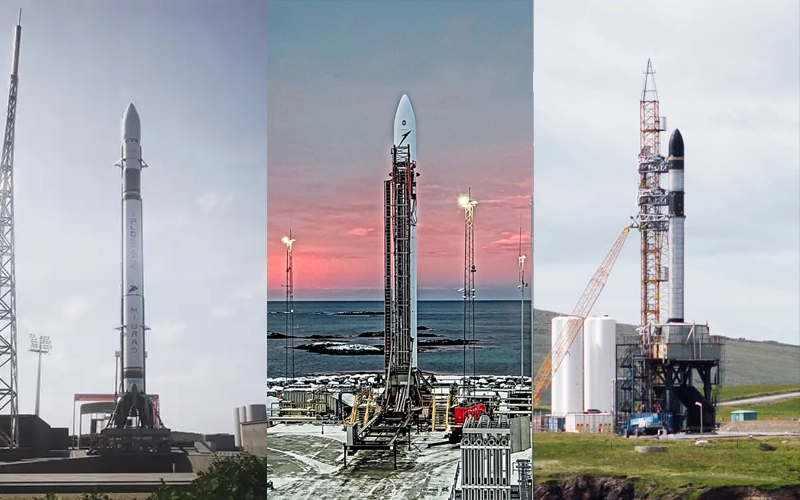
The European Space Agency has signed the first contracts under its European Launcher Challenge, committing a combined €543.6 million to Isar Aerospace, Rocket Factory Augsburg, and PLD Space. MaiaSpace was notably not among the awardees, with the agency stating that the contract award process with the company is “expected to resume in the coming weeks.”
In a 27 August announcement, ESA outlined the value of the three contracts, with Isar Aerospace receiving €197.8 million, Rocket Factory Augsburg €186.9 million, and PLD Space €158.9 million. This funding is, however, conditional.
Each contract is split into two components. Under Component A, the companies must successfully reach orbit by the end of 2027 before ESA begins using the available funding to support operational launches through 2030. Component B co-funds upgrades to the companies’ rockets, with each company required to demonstrate the proposed upgrades by the end of 2028. The amount of funding allocated to each company under each component was decided by participating Member States at ESA’s Ministerial Council meeting in November 2025 (CM25).
The funding allocations at CM25 followed an open call for proposals launched by ESA in March 2025 and the preselection of five providers in July 2025. Following the agency’s Ministerial Council meeting, the shortlisted companies submitted final proposals in a second tender stage, which closed in April 2026.
Signing the contracts with the three providers marks the beginning of the implementation phase of the European Launcher Challenge (ELC), which secured €902.16 million in subscriptions during CM25. That figure, however, includes a significant contribution from the United Kingdom, which has been left unassigned since Orbex closed its doors earlier this year. The country has not yet decided how the bulk of its contribution will be used.
The focus now shifts to whether the selected companies can actually deliver on the promise behind that funding.
“ESA has set the Challenge and created the conditions for new European launch providers to accelerate their ramp-ups and grow,” says ESA’s head of strategy and launches for Space Transportation, Lucia Linares. “Now it is up to the challengers to prove they can deliver reliable launch services for Europe and compete: getting to space is not easy and never guaranteed.”
Of the three companies, Isar Aerospace is the only one to have already attempted an orbital launch, although the mission was ultimately unsuccessful. The company is currently preparing for the second flight of Spectrum. A 15 June launch attempt from Andøya Spaceport in Norway was scrubbed after Isar Aerospace detected off-nominal behaviour in the rocket’s fluid systems. No new launch date has been announced.
RFA is preparing for the inaugural flight of its RFA ONE rocket from SaxaVord Spaceport in Scotland. Its preparations suffered a setback in late July when an issue discovered during pad testing forced the company to destack the vehicle for further investigation. PLD Space is also working towards the inaugural flight of its MIURA 5 rocket. The launch is expected to take place from the Guiana Space Centre in French Guiana before the end of 2026.