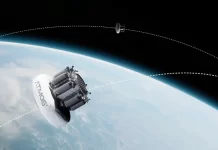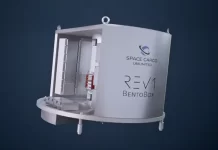
German space logistics company ATMOS Space Cargo has completed an early-stage design study for its reusable Phoenix 3 spacecraft. The announcement comes just two months after the company pushed the launch of its Phoenix 2 spacecraft from the second half of 2026 to early 2027.
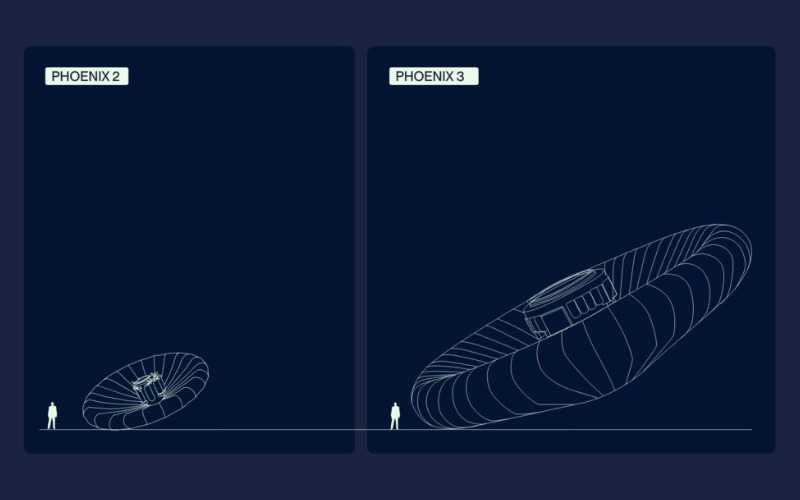
Work on the Phoenix 3 study was conducted with the European Space Agency at the agency’s Concurrent Design Facility (CDF) at ESTEC in the Netherlands. Teams assessed a version of the spacecraft capable of carrying payloads of more than 1,000 kilograms. When reentering Earth’s atmosphere, it would deploy a large inflatable atmospheric decelerator to enable its safe recovery.
The Pre-Phase A CDF study examined the spacecraft’s overall design, mission architecture, and key technical requirements, including its aerodynamics, thermal protection, propulsion, and reentry profile. According to ESA’s Daniela Lomanto, the study will offer a “solid starting point for Phase A, in which ATMOS will focus on the optimisation of aerodynamics, stability and thermal design, and on improving entry modelling and guidance to increase landing accuracy.”
ESA’s involvement was managed through the agency’s Third Party Activity initiative, which gives European companies access to the agency’s engineering expertise, consultancy services and testing infrastructure. This means that while ESA assisted with this element of the spacecraft’s development, Phoenix 3 is not an ESA programme and the work does not represent a funding award from the agency.
In addition to its support from ESA, this initial stage of development for Phoenix 3 was funded through a €25.7 million Series A round ATMOS closed in April. The company said at the time that the funding would be used to build an initial fleet of three Phoenix 2 vehicles, establish its ATMOS WORKS business for government and defence customers, and begin development of Phoenix 3.
The company is currently targeting 2030 for the first flight of a Phoenix 3 spacecraft. In the near term, however, ATMOS says it is focused on the rapid development of Phoenix 2.
“ATMOS’s near-term focus remains the three-flight Phoenix 2 mission campaign, aimed at multi-week in-orbit payload and spacecraft operations and the controlled return of commercial payloads from low Earth orbit to European recovery in the Azores, Portugal,” the company said in an 18 August press release.
The launch of the first Phoenix 2 spacecraft appears to have slipped by several months. On 5 March, ATMOS said the Phoenix 2.1 mission was planned for the second half of 2026, while a submission published through ESA’s Open Space Innovation Platform the following day gave a more specific target of the end of 2026. By 19 June, however, a later ATMOS submission on the same platform listed a planned Phoenix 2.1 launch in early 2027, the first public indication of the revised schedule. ATMOS has not publicly explained the reason for the delay.