ArianeGroup subsidiary MaiaSpace has shipped full-scale mechanical models of the first and second stages of its Maia rocket to French Guiana. The stages will be used for a series of combined tests at the Guiana Space Centre in the first half of 2027.
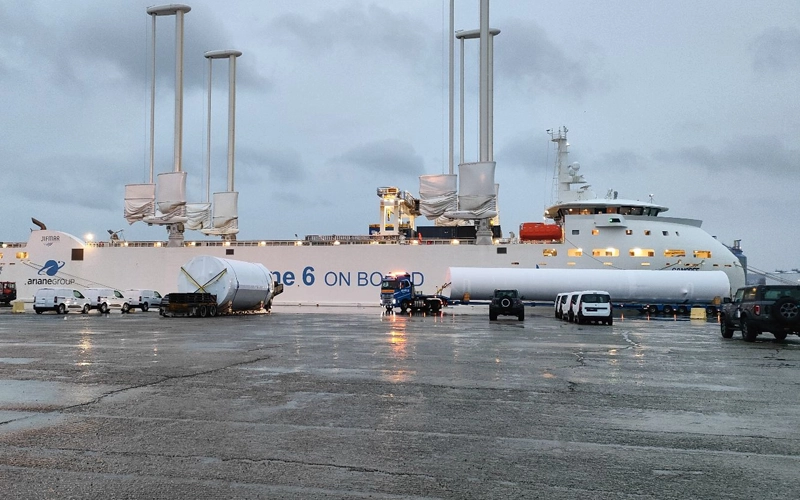
MaiaSpace announced on 25 November that the two stages left the company’s facility in Vernon on 19 November, heading for the port of Le Havre. The stages were then loaded aboard the transport ship Canopée, the same vessel used to transport Ariane 6 rocket stages, on 22 November for the ship’s 10-day voyage to the port of Pariacabo in Kourou.
According to the company, this initial shipment is intended to validate each step of the process that will be used to transport flight hardware from the company’s production facilities in mainland France to its launch site at the Guiana Space Centre. The stages themselves will be used to rehearse a number of key operations that will be performed during every Maia launch campaign.
MaiaSpace expects to begin this testing in the first half of 2027. The company will first integrate the two stages horizontally before mounting the vehicle onto its transporter-erector and then transferring it to the launch pad, where it will be raised into a vertical position. It will then test the connection and disconnection of the rocket’s electrical and fluid interfaces, validating several ground support systems.
Maia rockets will be launched from the Guiana Space Centre’s former Soyuz launch facility, which MaiaSpace is adapting for its partially reusable rocket. In February, after signing an agreement allowing it to occupy the facility, the company said it was targeting the end of 2026 to have a vehicle standing vertically on the launch pad for combined testing. Its latest update suggests that this milestone has slipped into the first half of 2027.
In July, MaiaSpace confirmed to European Spaceflight that it had abandoned plans to conduct a suborbital test flight of its Maia rocket, opting instead to proceed directly to an orbital launch attempt in the second half of 2027. In a report published by Ouest-France on 22 November, a MaiaSpace spokesperson explained that the company was now targeting a first orbital flight by the end of 2027. If Berger’s Law holds true, however, Maia’s inaugural flight could slip into 2028.
Coined by Ars Technica senior space editor Eric Berger, the law suggests that any rocket targeting an inaugural flight in the fourth quarter of a year with more than six months’ notice will invariably see its debut delayed to the following year.