
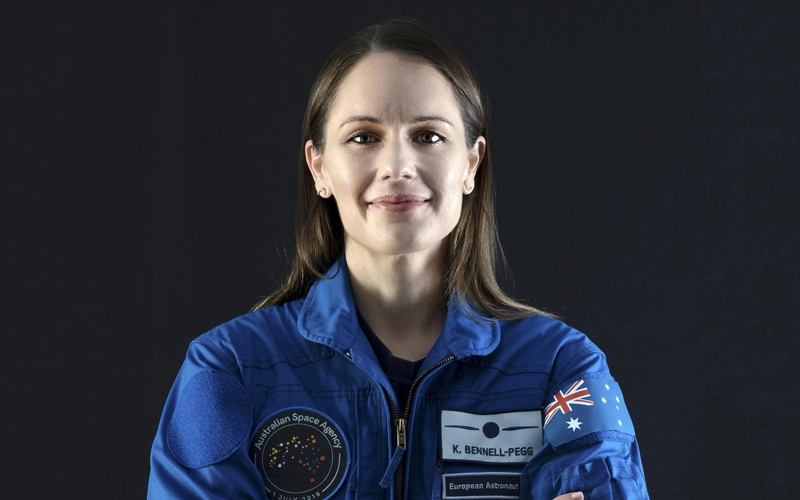
The Australian government has submitted a counteroffer to the European Space Agency (ESA) to secure a flight to the International Space Station for Australian astronaut Katherine Bennell-Pegg. Support for the mission is not universal in Australia, with one government official calling the spending “reckless.”
Australian Minister for Science Tim Ayres confirmed on 23 October that the government had formally responded to an offer from ESA earlier this year. Bennell-Pegg completed basic astronaut training at ESA’s European Astronaut Centre in Germany in April 2024, becoming the first person to qualify as an astronaut under the Australian flag.
ESA initially extended an invitation to Australia in early 2026. Although the agency has not confirmed the connection, the opportunity is likely linked to its planned ESA-Provided Institutional Crew (EPIC) mission. The mission would see ESA charter a SpaceX Crew Dragon spacecraft to transport its astronauts to the ISS for approximately one month in early 2028.
The cost of Australia’s potential place on the proposed mission has been a significant obstacle. Speaking on 21 October, Ayres said Australia’s required contribution was “well north of $100 million dollars”, adding that the government would need to secure financial support from state governments and private backers.
“This can only be delivered if it’s delivered with the Commonwealth and all of the states and private philanthropy being engaged in this effort right across Australia,” Ayres said.
The exact financial terms of Australia’s counteroffer have not been disclosed. However, Health Minister Mark Butler confirmed on 23 October that South Australia had committed funding, alongside several million dollars in philanthropic pledges. In a separate statement on 23 October, the #flyKatherine campaign, an industry-led initiative supporting Bennell-Pegg’s mission, said it had secured approximately A$25 million in cash and in-kind commitments from state governments, industry, universities and private donors.
“We recognise that the government must weigh competing budget priorities,” campaign spokesperson Larissa Wiese said. “The support assembled around this mission gives it a strong foundation on which to build, and absolute value for the taxpayer.”
The prospect of using taxpayer funds to finance the mission has drawn criticism. In comments to The Australian published on 1 October, Northern Territory Acting Chief Minister Gerard Maley questioned the government’s spending priorities.
“It’s reckless and shows the PM’s priorities are way out of touch with Australians,” Maley said.
ESA has yet to publicly respond to Australia’s counteroffer. However, a spokesperson for Science Minister Tim Ayres told ABC News on 23 October that the government expected a response before the end of 2026.

About US$400 m (~AU$600 m) for a Dragon light doesn’t sound unreasonable, so “well north of” AU$100 m for one seat in four also doesn’t sound unreasonable.
Spaceflight and space industries have little support in the current Australian Labor government – it has pulled funding for a number of projects.
It may nevertheless be academic given SpaceX’s coming retirement of Dragon and Falcon 9 unless said mission is already booked.