
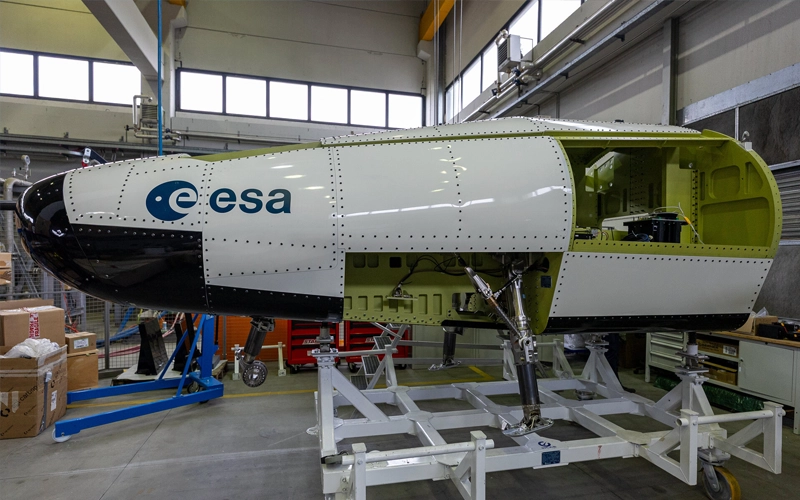
The European Space Agency (ESA) has provided new details about the failed Space Rider drop test, confirming that the vehicle’s parafoil detached during deployment, sending the full-scale test model back to terra firma more rapidly than planned.
Speaking at an ESA media briefing on 22 October, Géraldine Naja, the agency’s Director of Space Transportation, provided further details about the failed test, which European Spaceflight first reported on 20 October.
According to Naja, the failed test took place on 6 October, when the test model was released from a helicopter at an altitude of approximately three kilometres over a military test range in Sardinia, Italy. The initial drogue parachute deployed successfully, slowing the vehicle as intended. However, the subsequent deployment of the parafoil, which is designed to guide Space Rider to a controlled landing, was unsuccessful.
“Unfortunately, the parafoil detached itself from the mock-up,” Naja said. Without the parafoil to control its descent, the test model crashed into the ground.
Naja confirmed that teams had recovered remnants of the test model and that an investigation board had been established to determine the cause of the failure. She added that investigators had not yet identified what caused the parafoil to detach.
The failed test was intended to demonstrate Space Rider’s complete descent and landing sequence using a model representative of the spacecraft’s mass, shape and inertia. Naja explained that earlier qualification campaigns had successfully demonstrated individual elements of the landing system, including parafoil deployment, autonomous guidance and the transition from the drogue parachute to the parafoil.
Despite the latest setback, ESA does not currently expect the failure to delay the development of Space Rider.
Naja said that the remaining qualification activities were not on the programme’s critical path, meaning that development work could continue while the cause of the failure was investigated. However, she cautioned that the schedule would be reviewed once the investigation board had completed its work.
“We are very confident that it does not harm the continuing development of Space Rider,” Naja said.
Space Rider is being developed as Europe’s first reusable uncrewed orbital spacecraft, capable of carrying experiments into low Earth orbit and returning them to Earth for recovery. Even after the failed drop test, ESA is still targeting the first half of 2028 for the vehicle’s inaugural flight aboard a Vega C rocket.


Where is the video of the Drop Test?
No footage of the test has been released yet.