
According to NASA Administrator Jared Isaacman, Italy has committed more than $5 billion to the development of a lunar habitat for the agency’s Moon Base programme. In return, the country has secured spots for two Italian astronauts on future missions to the surface of the Moon.
Speaking during the Air & Space Forces Association’s Air, Space & Cyber Conference on 15 September, Isaacman cited Italy’s contribution to NASA’s lunar exploration programme as an example of what he described as a “good deal” with an international partner. The centrepiece of that contribution is the Multi-Purpose Habitat (MPH), a pressurised lunar habitat module being developed by Thales Alenia Space under an Italian Space Agency (ASI) contract for future long-duration missions to the Moon.
“They’re committing over $5 billion to building one of the first habitation modules,” Isaacman said. “It likely will be the first real habitation module that makes its way to the lunar surface. And as a result, you’re going to see two Italian astronauts on the surface of the Moon.”
When Italy and NASA signed a Statement of Intent in March, they agreed that at least one Italian astronaut would take part in a future Artemis lunar mission. Less than a month later, the late ASI President Teodoro Valente said that figure had increased to two following discussions with NASA in Washington, although he stressed that the arrangement had “not yet been officially formalised.” Isaacman’s latest comments appear to provide the clearest confirmation yet that Italy is, in fact, expected to receive two lunar surface opportunities for its astronauts.
Isaacman’s comments come as Italy and NASA prepare to formalise the next stage of their lunar cooperation. In a 9 September summary of its efforts at the International Space Summit in Paris, the Italian Space Agency (ASI) said its delegation had met with NASA ahead of the signing of a new agreement in Washington covering Italy’s contribution of the MPH.
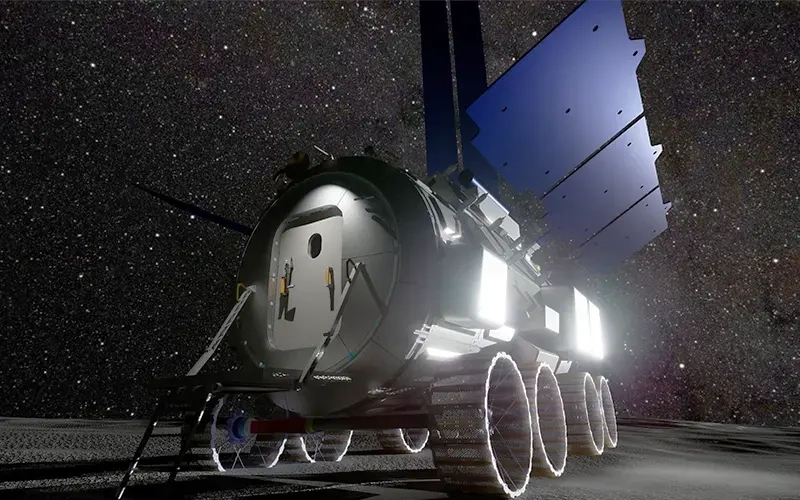
The MPH module is expected to measure three metres in width and six metres in length, with a mass of roughly 15 tonnes. It was designed to accommodate two astronauts for missions lasting between seven and 30 days. It will be equipped with wheels for precise positioning on the lunar surface, enabling it to support crewed missions at different locations. This functionality could, however, be revisited now that NASA is moving towards a more fixed Moon Base architecture.
Most recently, the MPH design passed a System Requirements Review in May, allowing the project to progress towards a Preliminary Design Review expected in 2027. It is currently expected to be ready in 2032 ahead of a launch in 2033.