French launch startup Sirius Space Services has successfully test-fired a complete prototype of its STAR-1 rocket engine for the first time.
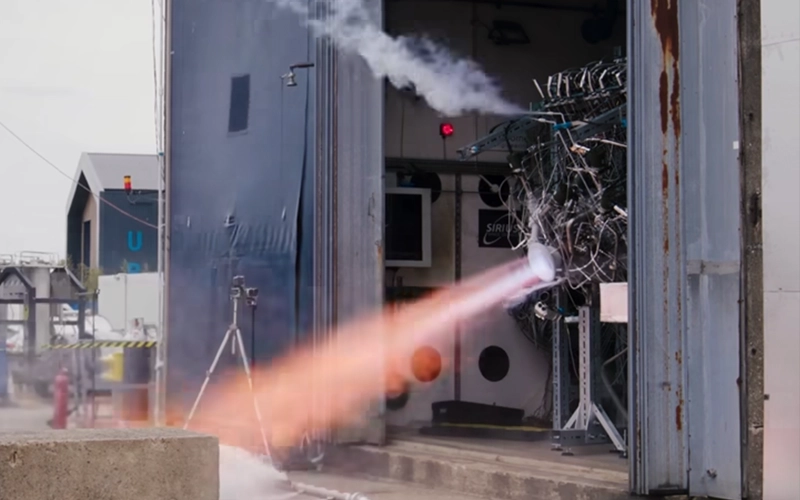
The company announced the milestone on 12 September, stating that it had conducted the first hot-fire tests of the complete STAR-1 engine at Airborne Engineering’s propulsion test facility in southern England.
While the company didn’t provide specific dates, saying only that the campaign was conducted “this summer”, it said the testing included multiple successful ignitions. While the lack of a specific test date leaves open the possibility that the campaign was completed within the company’s original schedule, the September announcement suggests that it may have slipped slightly from the timeline Sirius Space outlined in March, when it said full-scale engine tests were expected during the first half of 2026.
According to the company, the testing included multiple successful ignitions. These tests marked the first time that all of the engine’s critical subsystems had operated together. These included the turbopumps, combustion chamber, injector plate, avionics and software.
The liquid oxygen and methane-fuelled (methalox) STAR-1 is designed to produce 55 kN of thrust. The engine will be used across the company’s planned family of launch vehicles, which will use a common core stage featuring nine STAR-1 engines.
Sirius Space is planning to launch the first commercial flight of its single-stick Sirius 1 rocket in 2028. The rocket is designed to deliver payloads of up to 180 kilograms to low Earth orbit. This will then be followed by the introduction of the two-booster Sirius 13 rocket, which will be capable of carrying up to 800 kilograms, and the four-booster variant, which will be capable of carrying up to 1,100 kilograms.
Before it begins launching payloads into space aboard Sirius 1 in 2028, the company is planning a suborbital test flight in 2027 aboard the Sirius 1B demonstrator. According to the company, this flight will “validate the launcher’s key technological building blocks and performance under real conditions.”