
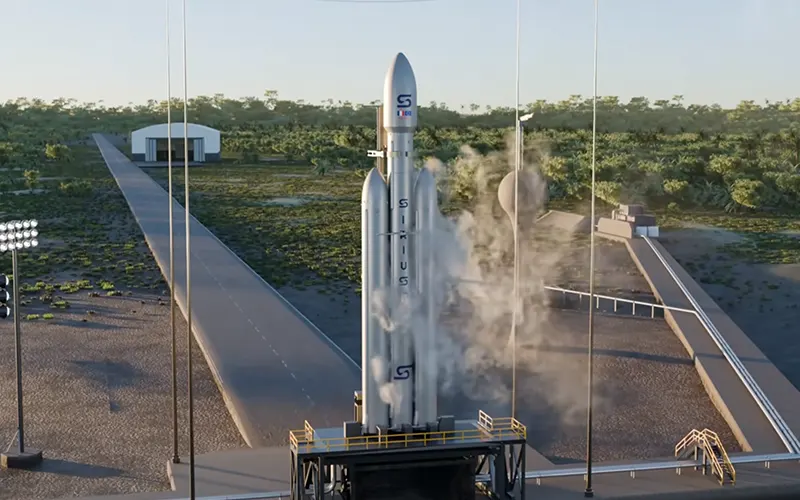
The French space agency CNES has selected Sirius Space Services to fill a vacancy at the Guiana Space Centre’s new multi-user commercial launch facility. The space became available after MaiaSpace shifted its planned launch operations to the spaceport’s former Soyuz launch facility.
In 2021, CNES opened a call for interest in a new commercial launch facility that it would build on the grounds of the old Diamant launch site at the Guiana Space Centre. On 25 July 2025, the agency announced seven companies that had been shortlisted: HyImpulse, Isar Aerospace, PLD Space, Rocket Factory Augsburg, Latitude, MaiaSpace, and Avio.
Since that announcement, Avio and HyImpulse have been removed from the list, with CNES offering no explanation. MaiaSpace voluntarily gave up its space after CNES, in September 2024, selected the company to assume control of the former Soyuz launch facility, now renamed ELM2. In January 2026, the agency published a notice inviting interested launch operators to fill the vacancy left by the ArianeGroup subsidiary.
According to an 18 June CNES press release, a selection committee chose Sirius Space Services on 23 April to fill the vacancy. In an 18 June announcement, the company called it a major milestone that brought it closer to its inaugural commercial flight in late 2028.
“A global benchmark for launch activities, the Guiana Space Centre is today opening a new chapter in our space journey,” the statement read. “We are proud to join this iconic site and to participate in the emergence of an increasingly ambitious European space industry.”
Sirius Space is developing a range of three rockets based around common rocket boosters. The smallest is Sirius 1, a two-stage, single-stick rocket capable of delivering payloads of up to 180 kilograms to orbit. Sirius 13 adds two strap-on boosters, increasing payload capacity to 800 kilograms, while the largest vehicle, Sirius 15, features four boosters and tops out at 1,100 kilograms.
While Sirius Space is the newest addition to the future ELM multi-user facility, PLD Space will likely be the first company to use it. The company has already begun construction of its dedicated infrastructure at the site, investing €35 million in its development. It plans to complete the work this summer ahead of the inaugural flight of its MIURA 5 rocket before the end of the year.