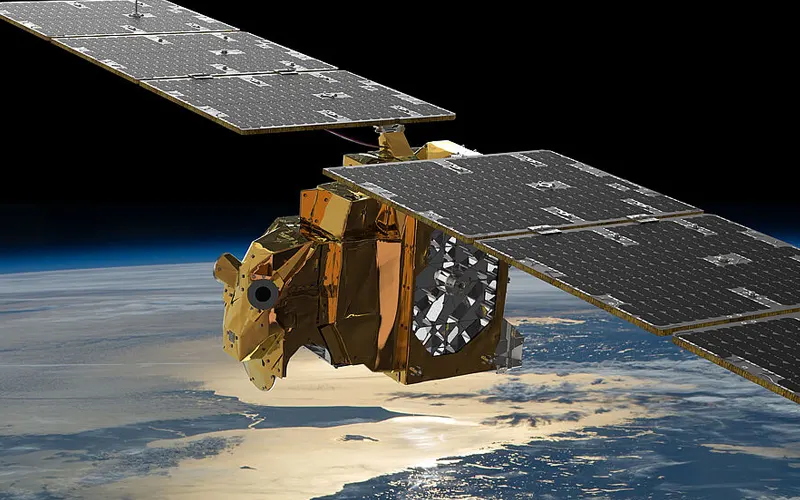
German space technology company OHB has been awarded a €248 million contract by the European Space Agency to develop and build 20 small satellites for EUMETSAT’s EPS-Sterna weather satellite constellation.
The EPS-Sterna constellation is an expansion of the capabilities successfully demonstrated by the Arctic Weather Satellite, which was launched aboard a SpaceX Falcon 9 in August 2024. The €32.5 million satellite, which is still operational, was tasked with providing high-precision Arctic weather forecasts. The future EPS-Sterna constellation will offer a more comprehensive view of weather variability in the Arctic, with measurements of atmospheric water vapour being particularly important.
On 18 March, ESA announced that the European Organisation for the Exploitation of Meteorological Satellites (EUMETSAT) had given the green light to proceed with the development of the full constellation. The agency, on behalf of EUMETSAT, awarded the contract to build the constellation’s twenty satellites to OHB Sweden, the Swedish subsidiary of OHB that had also been responsible for the development of the Arctic Weather Satellite.
“Remarkably, for a prototype, data from the Arctic Weather Satellite are being assimilated into operational weather forecasts by the European Centre for Medium-Range Weather Forecasts,” said ESA’s Director of Earth Observation Programmes, Simonetta Cheli. “All of this gives us strong confidence as we move forward with the new EPS-Sterna constellation in cooperation with EUMETSAT.”
The EPS-Sterna constellation will comprise six satellites in orbit at any one time. These satellites will be replenished twice to ensure operational continuity until at least 2042. In addition to the 18 satellites that will make up the three waves of six-satellite constellations, OHB will also build two additional satellites as backups. Each satellite will carry a cross-track scanning microwave radiometer that will provide detailed profiles of atmospheric humidity and temperature.
ESA expects the first six satellites of the constellation to be launched in 2029.