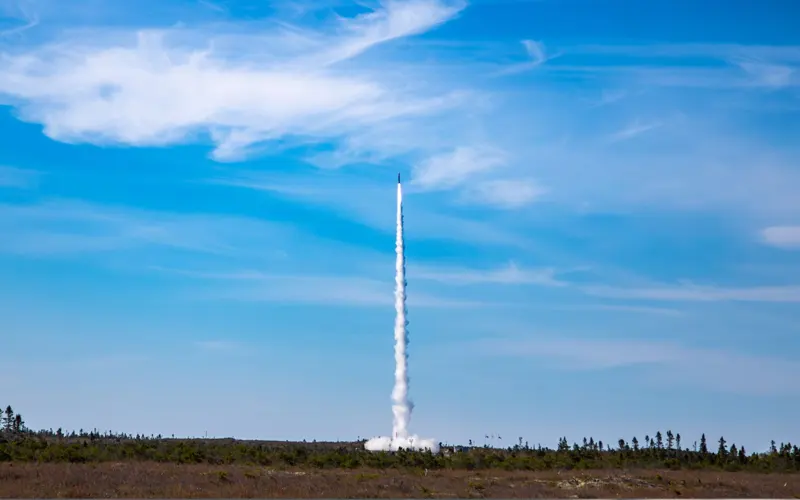
A single-stage sounding rocket launched by Dutch firm T-Minus Engineering from Spaceport Nova Scotia on 10 June suffered an anomaly late in its flight. The anomaly prompted teams to stand down from a second planned flight.
Founded in 2011, T-Minus Engineering develops and operates a range of suborbital rockets for microgravity research and hypersonic experimentation. The largest of its rockets is the Barracuda, a sounding rocket that stands approximately four metres tall and can carry payloads of up to 40 kilograms to altitudes of around 120 kilometres.
The 10 June flight was launched at 14:51 CET. In addition to validating the rocket’s performance, the flight was intended to enable Maritime Launch Services, the commercial operator of the site, to refine launch procedures and safety and security systems in preparation for the commencement of full-scale operations in the coming years.
According to a 10 June Maritime Launch Services press release, while the single-stage, solid-fuel rocket operated “nominally during the powered phase of flight,” it experienced an “anomaly late in the boost phase.” European Spaceflight contacted T-Minus Engineering for details about the nature of the anomaly but had not received a response at the time of publication.
A second flight, expected to follow shortly after the first, was abandoned after the anomaly to “review mission data and incorporate lessons learned into future testing activities.” Despite this, T-Minus Engineering co-founder Roel Eerkens said it was an important step in developing the company’s rocket.
“It moves us closer to providing research institutions and defence organizations with meaningful access to near-space environments and high-performance platforms for testing, training, and technology development,” said Eerkens.
Despite the confidence, last week’s flight was the second consecutive Barracuda launch from Spaceport Nova Scotia to underperform. A November 2025 Barracuda sounding rocket launch was initially described as successful. However, in a subsequent interview, Maritime Launch Services CEO Stephen Matier said the T-Minus team had hoped the vehicle would reach the Kármán line, the internationally recognised boundary of space at an altitude of 100 kilometres, but that it fell short of that target.
Interestingly, Maritime Launch had previously described Barracuda as capable of carrying payloads of up to 40 kilograms to an altitude of 120 kilometres following the November 2025 launch. In its statement after the 10 June flight, however, the company described the vehicle as capable of carrying the same payload mass to approximately 80 kilometres. The reason for the revised figure was not explained.