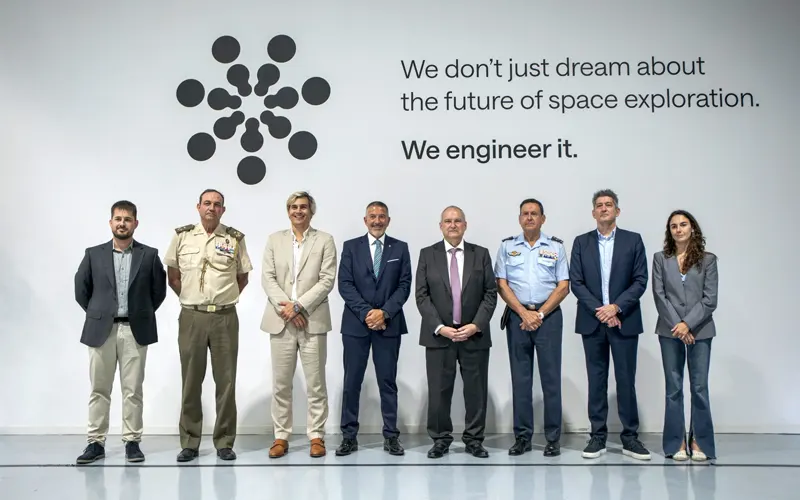
Pangea Propulsion has inaugurated a new 1,000-square-metre manufacturing facility in L’Hospitalet de Llobregat, near Barcelona, investing an initial €1 million in its establishment. According to the company’s CEO, Adrià Argemí Samsó, the opening of the new facility marks the company’s shift to serial production.
“For years we have worked to demonstrate more efficient, sustainable and reusable propulsion technologies,” Argemí said. Today we take the next step: to turn that innovation into products ready to make our customers’ missions a reality.”
Founded in 2018 as Pangea Aerospace, Pangea Propulsion initially developed a small launch vehicle called Meso, which it abandoned in 2023 to focus on propulsion solutions. In April, the government of Catalonia, an autonomous region of Spain, announced a €2 million financing agreement with Pangea Propulsion to bolster the company’s manufacturing capacity, with €1 million to be made available during the project’s first phase. The new facility appears to be the first phase of that project, though the company has not confirmed the connection.
While Pangea Propulsion has already invested €1 million, it intends to invest a total of €7 million in its new facility over the next three years.
The company currently offers a suite of small in-space propulsion thrusters known as Nereus, as well as its larger Cryox engine for launch vehicle upper and kick stages. One of its new facility’s first undertakings will be to integrate a Nereus propulsion system with a reentry capsule being developed by an undisclosed private customer. The associated mission is expected to be ready for flight in early 2027.
In addition to its smaller propulsion systems, the facility will also host the assembly of the company’s Arcos aerospike engine. Pangea Propulsion is also working on its Kronos engine, which is part of an ESA-funded project to design a rocket engine for future heavy- and super-heavy-lift launch vehicles.