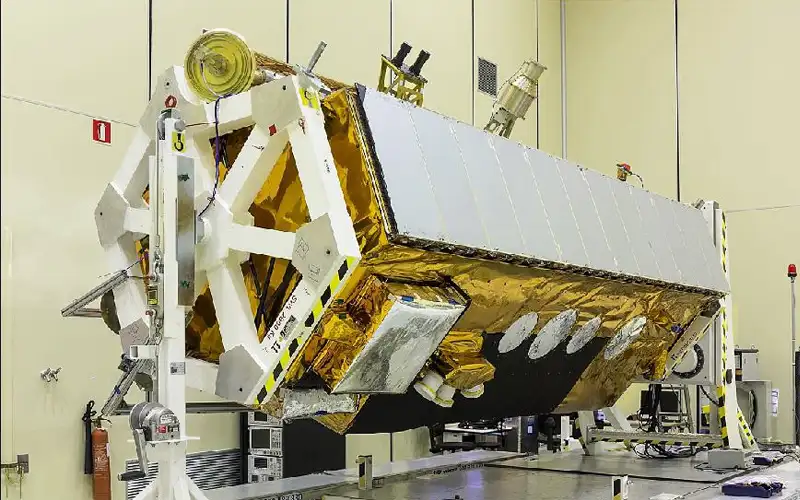
Spain’s Council of Ministers has approved a loan agreement under which national satellite operator Hisdesat will receive €1.011 billion over eight years to develop a pair of PAZ 2 satellites.
The PAZ-1 synthetic aperture radar was launched aboard a SpaceX Falcon 9 in February 2018. It delivers high-resolution Earth observation imagery for a wide range of applications, including border control, intelligence, environmental monitoring, and crisis management. With the development of PAZ-2, the Spanish government, through commercial operator Hisdesat, is looking to significantly increase the system’s capacity.
During a Council of Ministers meeting on April 15, representatives from the Ministry of Defence emphasised the importance of maintaining Spain’s space-based radar imaging capability beyond the lifespan of PAZ-1. According to the government, Hisdesat does not have the financial capacity to fund the development of the next-generation PAZ satellites, and financing from other sources was “not possible.” This justified the Ministry of Industry and Tourism’s decision to provide a €1,011,850,000 loan, to be disbursed in instalments between 2025 and 2032.
Hisdesat is expected to receive an initial €76 million of the total amount in 2025. In 2026 and 2027, this figure will increase to €179 million and €182 million, respectively. The two largest instalments will be awarded in 2028 and 2029, with €213 million and €272 million allocated, respectively. From 2030 to 2032, the PAZ 2 satellites are expected to enter service, with the loan amounts reflecting this and dropping to well below €100 million per year.
The loan agreement with Hisdesat represents a level of state financing that surpasses the usual limits applied to government-backed programmes in Spain. In fact, the figures outlined in the agreement exceed the thresholds set out in Spain’s General Budget Law, both in total value and repayment duration. As a result, the government has had to request and obtain authorisation from the Council of Ministers to override these limits, something that is permitted under Article 47, Section 3 of the law.
The government is not merely a passive contributor to the project, however, given its 30% stake in the company. The only shareholder with a larger stake in Hisdesat is Hispasat, which owns 43%. However, in February 2025, Spanish aerospace and IT contractor Indra reached an agreement to acquire 89.68% of Hispasat. This is significant because the Spanish government holds a 28% stake in Indra through SEPI, making it Indra’s largest shareholder. As a result, Indra’s acquisition of Hispasat will increase the government’s indirect influence over Hisdesat.