
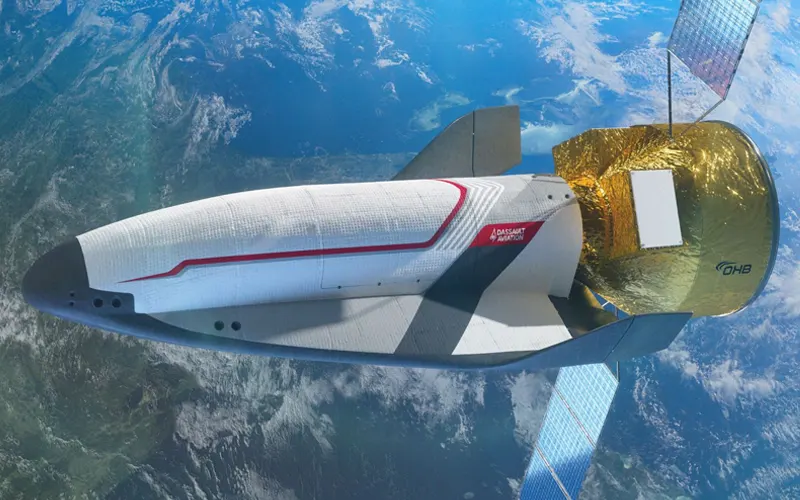
German space technology company OHB has agreed to develop the service module for Dassault Aviation’s VORTEX-S spaceplane, which the companies plan to pitch to the European Space Agency (ESA).
During the Paris Air Show in June 2025, Dassault Aviation revealed plans for its VORTEX spaceplane, short for Véhicule Orbital Réutilisable de Transport et d’Exploration (Reusable Orbital Transport and Exploration Vehicle). The vehicle is designed to transport cargo to and from space stations in low Earth orbit, to conduct autonomous free-flying missions, and potentially to ferry crews to and from space.
An initial subscale demonstrator of the spaceplane, called the VORTEX-D, is being developed by the company with support from the French Ministry of the Armed Forces. During a 25 June 2025 hearing of the French National Assembly’s Committee on National Defence and the Armed Forces, it was revealed that the demonstrator is expected to be launched in 2028 and has a total project cost of €70 million, with Dassault providing more than half of the funding and the remainder coming from the French government.
The VORTEX-S is expected to follow the VORTEX-D demonstrator. This larger, more complex variant will be developed in partnership with OHB following the finalisation of the 11 May agreement, as the companies seek to secure ESA backing for the project. According to the release announcing the partnership, discussions are also underway with other major European space companies to “expand the team.”
“With the Vortex-S proposal to ESA, we aim to strengthen Europe’s space capabilities,” said Dassault Aviation CEO Éric Trappier. “Our German friends at OHB are natural partners to participate in this project, bringing their remarkable expertise.”
Dassault Aviation will act as the project’s prime contractor and will be responsible for the spaceplane, while OHB will lead development of the service module. Together, the two companies will form the project’s “core team.”
While the partnership with OHB is specifically focused on the VORTEX-S variant, Dassault Aviation has presented the vehicle as just one step in a broader development roadmap. Additionally, the way the roadmap defines each variant appears to conflict with the most recently stated capabilities of the S variant.
In its 11 May announcement, Dassault Aviation said VORTEX-S would be “capable of round-transport to space stations and of autonomous orbital free flyer missions.” However, the broader development roadmap published when VORTEX was first announced, which remains available on the company’s website, identifies the S variant as a subscale vehicle focused solely on free-flyer missions. VORTEX-C was expected to be the first full-scale variant and would be capable of transporting cargo to and from low Earth orbit. The inclusion of cargo transportation capability in the VORTEX-S variant may indicate which ESA programme the new partnership intends to target.
ESA’s LEO Cargo Return Service initiative was launched in May 2023 and aims to foster the development of a sovereign European space cargo transport capability. At the time, the agency expected the successful bidders to launch a demonstration mission to the International Space Station (ISS) by 2028. In May 2024, the agency awarded two Phase 1 contracts to The Exploration Company and Thales Alenia Space, with each company receiving €25 million to mature the design of its respective vehicle.
In early 2026, the agency published a call for Phase 2 of the project, explaining that it would be open to all bidders and not just those companies that were involved in its first phase. Under this call, the project had been rescoped to outline two options for a demonstration mission. The first would be to the ISS in the first quarter of 2029. The second would be to a future commercial space station, with the mission to be carried out by the end of 2031.
With this extended timeline available, Dassault Aviation may be looking to launch its demonstration mission and then consolidate the development of its VORTEX-S and C variants into a single vehicle for the purposes of bidding on Phase 2 of ESA’s LEO Cargo Return Service initiative.


With the ISS entering its final operational years and no European initiative to build a new space station, it remains a big question mark who the customers will be for all these European cargo projects. I have a suspicion that in ten years, we will have long forgotten about VORTEX and co.