The Netherlands has formalised the mandate of its rebranded space agency, adding the Ministry of Defence to its steering committee for the first time.
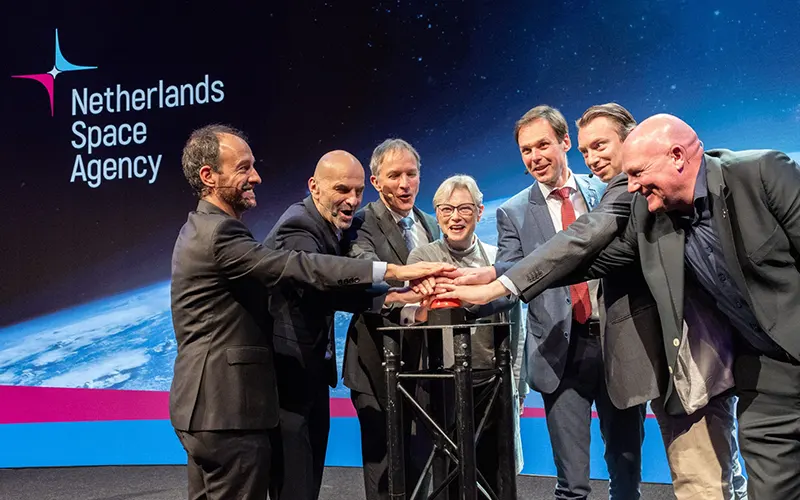
The formation of the new agency was announced on 3 March at the Amsterdam Space Symposium, with the Netherlands Space Office becoming the Netherlands Space Agency (NLSA). At the time, secretary general of the Ministry of Economic Affairs Sandor Gaastra explained that “strengthening the governance of space policy in the Netherlands is important in view of the growing strategic importance of space for security, the economy and autonomy.”
Following the renaming in March, the governance agreement and mandate for the new agency were officially signed on 12 June and published in the Government Gazette on 6 July.
In March, when the new agency was first announced, Dietmar Pilz, head of ESA’s ESTEC technical centre in Noordwijk, said the change would give the country a stronger platform from which to expand its influence in European space initiatives.
“With an agency, the Netherlands can represent its interests more effectively in European organisations such as ESA,” Pilz said. “This new name will make the Netherlands’ commitment and influence more visible.”
The country has set out five objectives for the new agency. These include improving the coordination and implementation of Dutch space policy, strengthening the country’s technological and scientific position, and building closer links between its research, industrial, and innovation sectors. It will also be tasked with identifying and addressing dependencies and vulnerabilities linked to the country’s space activities.
Despite its new name and mandate, the Netherlands Space Agency has not become a fully independent body. It remains part of the Netherlands Enterprise Agency within the Ministry of Economic Affairs and Climate. Its operating costs are jointly funded by the ministries responsible for economic affairs, infrastructure and water management, education, culture and science, and defence. The individual ministries also provide separate funding for programmes and activities that fall within their respective policy areas.
Those same ministries make up the new agency’s steering committee. This committee approves its multi-year programme, monitors its performance and spending, and oversees organisational decisions. Notably absent is the Dutch Research Council, which had been one of the parties that established the Netherlands Space Office in 2008 and held a seat on its steering committee. The new agreement states only that NWO’s continued involvement is no longer required, without providing a reason for its removal.
The new agency inherits a budget that was settled after a public tussle late last year. Ahead of ESA’s Ministerial Council meeting in November 2025 (CM25), the country’s cabinet proposed committing €344.3 million to ESA’s programmes for 2026 to 2028. While the country framed the proposal as maintaining its current spending levels, adjusted for inflation, it effectively amounted to a cut of approximately 25%.
The proposed freeze drew criticism from ESA director general Josef Aschbacher, who said, “The Dutch contribution to ESA is far below what I consider appropriate for your country.” Pressed on the warning from the ESA chief during parliamentary questions, Minister of Economic Affairs Vincent Karremans conceded that the risk was real. He acknowledged that structurally low investment in ESA could lead the organisation to relocate parts of ESTEC’s (European Space Research and Technology Centre) activities to other countries, noting that elements of the Human and Robotic Exploration directorate had already been relocated to Cologne.
The government ultimately increased its commitment to €453.3 million at the conference in Bremen. This, however, only covers the country’s commitments to ESA. Since the agency’s formation and the adoption of its new mandate, the country has not yet discussed any budget adjustments.