
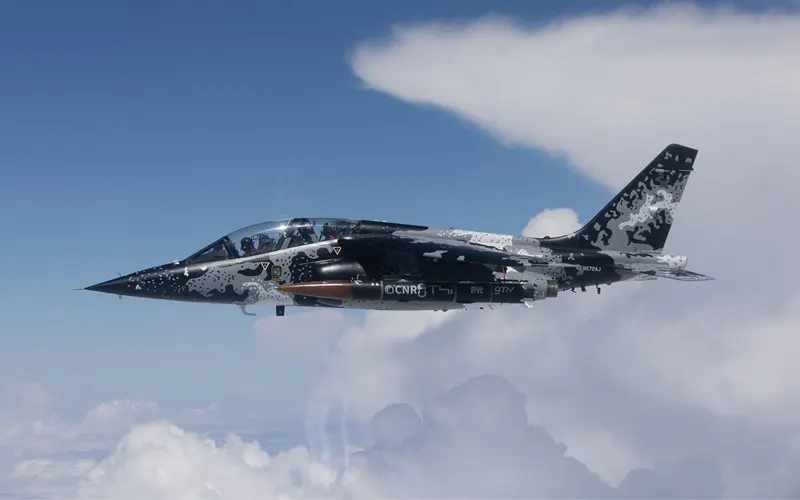
An Italian consortium has successfully completed a suborbital demonstration of an air-launched rocket system. The project, which utilised a Dornier Alpha Jet aircraft and T4i’s HAX25 sounding rocket equipped with avionics supplied by GMV, was initiated to support Italy’s push to develop a more responsive launch capability.
The Aviolancio programme, which translates roughly to “air launch programme”, was initiated by Italy’s Interministerial Committee for Space and Aerospace Policies and is coordinated by the National Research Council (CNR) on behalf of the Presidency of the Council of Ministers. The programme is supported by AIRBORNE, a facility within CNR’s Department of Earth System Sciences and Environmental Technologies, which focuses on technology testing and mission support for aerospace applications and suborbital launch activities. Initial testing began in February 2022 with a small, vertically launched rocket from Salto di Quirra in Sardinia, which was used to validate the hybrid propulsion system.
After completing a captive-carry test in September 2025, the Dornier Alpha Jet aircraft, carrying the HAX25 rocket under its wing, took off from the Houston Spaceport in Texas on 22 April. Approximately 100 kilometres off the coast, over the Gulf of Mexico, the rocket’s cluster of four hybrid motors was ignited, and the rocket was released.
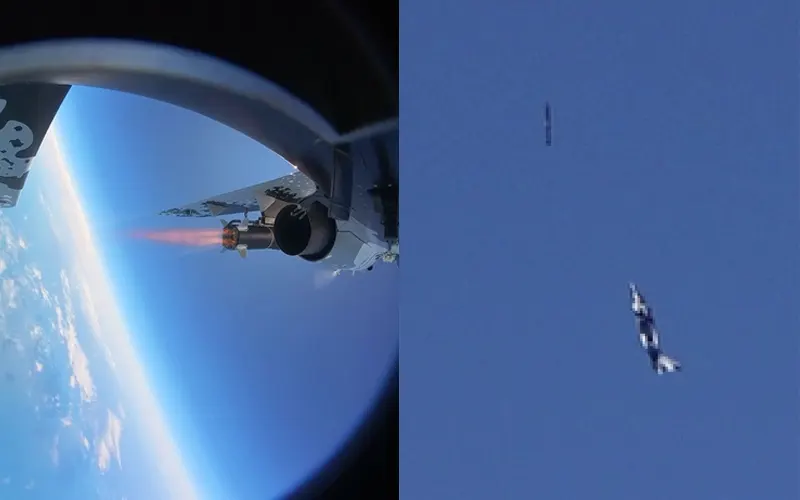
While a CNR update from September 2025 identified a target altitude of between 80 and 100 kilometres, a 7 May CNR press release outlining the system’s inaugural flight did not indicate whether that target had been met. The release did, however, state that the test “successfully verified the entire system under real-world conditions.”
Lucia Paciucci, Aviolancio project manager at CNR, explained that one of the most significant aspects of the demonstrated technology was its versatility.
“The ability to reschedule the flight just a few hours in advance (for example, due to changing weather conditions), while maintaining full technical and operational control, highlights a paradigm shift compared to launches from ground-based platforms, which are much more constrained by infrastructure, trajectories, and operational windows,” explained Paciucci.
Air-launched systems, however, have had a complicated history. The most significant examples of this kind of system are the Orbital Sciences (now Northrop Grumman) Pegasus and Pegasus XL systems and Virgin Orbit’s LauncherOne. Both demonstrated that while air-launched systems can offer a degree of operational flexibility, neither achieved commercial sustainability. Pegasus suffered a sharp decline in its launch cadence as customers migrated to lower-cost rideshare alternatives, and Virgin Orbit entered bankruptcy in 2023 after only six flights. That said, commercial viability may not be the only metric for success.
EU Commissioner for Defence and Space Andrius Kubilius has identified “quick launch response” as a key priority for Europe. In its press release announcing the successful flight, Italy’s Interministerial Committee for Space and Aerospace Policies similarly signalled the strategic importance of independent access to space. In that context, a government-funded and managed programme like Aviolancio, focused on responsiveness rather than commercial sustainability, may offer benefits that outweigh its potential cost.



“The ability to reschedule the flight just a few hours in advance (for example, due to changing weather conditions), while maintaining full technical and operational control, highlights a paradigm shift compared to launches from ground-based platforms, which are much more constrained by infrastructure, trajectories, and operational windows,”
Having difficulty seeing this. Aircraft flights and pad launches are subject to similar constraints with weather and air traffic restrictions. Wouldn’t a solid booster would be cheaper and a lot less trouble?