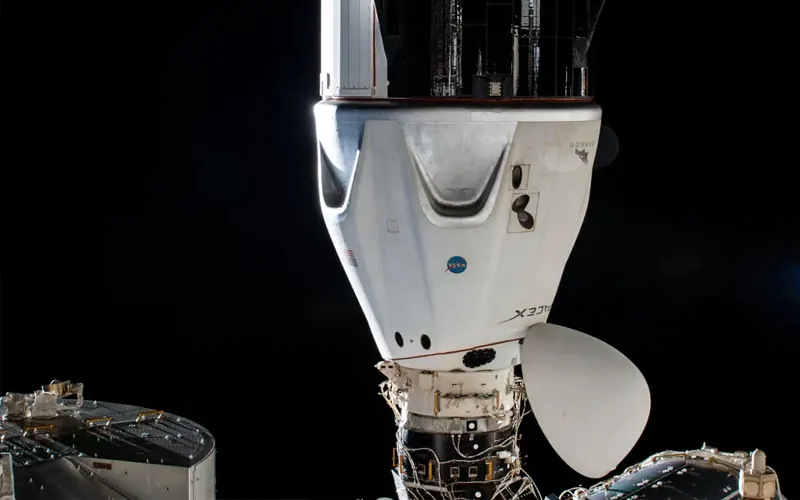
The European Space Agency (ESA) Director General Josef Aschbacher announced on 19 March that the agency intends to purchase a dedicated SpaceX Crew Dragon flight to the International Space Station (ISS) for its astronauts.
In November 2022, ESA announced its newest class of five career astronauts. Under the current barter agreement with NASA, ESA has secured a long-duration mission to the ISS for just one of the five, namely Sophie Adenot, who is currently aboard the station. With the ISS set to be decommissioned in 2030 and deorbited soon after, ESA is unlikely to secure additional long-duration missions to the station before its retirement.
On 19 March, following the 345th ESA Council meeting at the agency’s headquarters in Paris, Director General Aschbacher announced that Member States had endorsed the ESA Provided Institutional Crew (EPIC) mission. Director of Human and Robotic Exploration Daniel Neuenschwander explained that EPIC would differ from private missions to the ISS in its length and scope.
The four private Crew Dragon missions to the ISS launched to date through commercial provider Axiom Space have each spent approximately 18 days aboard the station, with one of the four being significantly shorter, at just 8 days. According to Neuenschwander, the agency’s EPIC mission is expected to be a “medium duration mission,” with the agency planning for approximately a month’s stay.
In addition to its duration, the mission will differ from a standard private mission to the station in its scope of work. Generally, private astronauts are trained and empowered to focus solely on specific experiments and tasks. As part of EPIC, ESA astronauts will be tasked with a broader set of responsibilities, including system maintenance and repair, as well as supporting logistics and cargo operations.
According to Aschbacher, the agency plans to implement the EPIC mission “with international partners,” but did not specify which partners or how many seats would be allocated to non-ESA astronauts. Reporting from Australia indicates that the agency has approached the country to participate in the programme, but there is no indication of whether an agreement has been finalised. Other potential partners could include Canada and the UAE, with which the agency signed a Memorandum of Understanding in late 2024 aimed at “fostering collaboration in space exploration.”
Keep European Spaceflight Independent
Your donation will help European Spaceflight to continue digging into the stories others miss. Every euro keeps our reporting alive.