The European Space Agency has opened its call for proposals to develop a crew launch abort demonstrator, a project first announced on 28 November 2025. With the call now open, the agency has published additional information about the project, including a budget of €1 million for this initial phase of the demonstrator’s development.
Officially opened for proposals on 10 April, the System Level Definition phase of ESA’s Launch Abort Demonstrator calls for the completion of the “first step towards derisking a Launch Abort System for a crew vehicle.” It will focus on modelling the entire launch abort sequence, with a particular emphasis on pad abort scenarios, and is expected to last no longer than 12 months.
While not overt, the call hints at a link between the Crew Launch Abort Demonstrator project and the agency’s LEO Cargo Return Service, which aims to foster the development of European commercial cargo transport and return services. As part of the LEO Cargo Return Service project, capsule designs are required to be capable of adaptation into a crewed vehicle, an evolution that would dovetail with the development of a launch abort system.
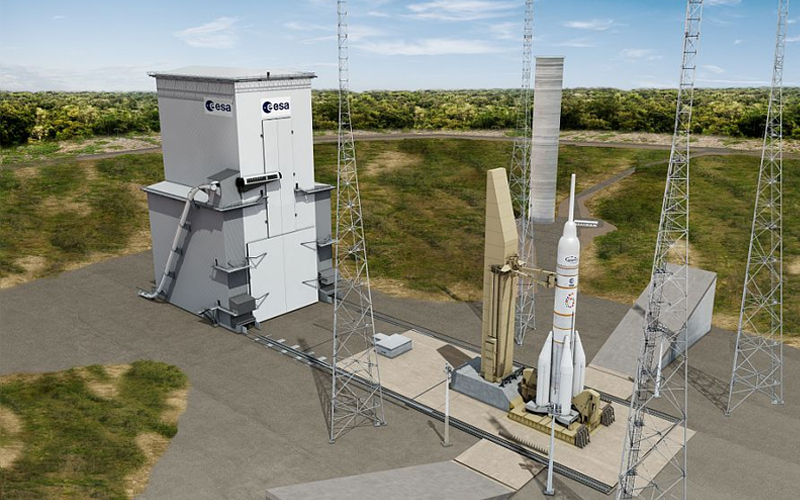
The baseline operational context for the proposed Crew Launch Abort Demonstrator will be an Ariane 6 rocket launched from the ELA4 launch facility at the Guiana Space Centre. The call does, however, add that initial testing is expected to be conducted at “an alternative European test range.”
In addition to a baseline launch vehicle and facility, the call also outlines reference data for a capsule that is based on a blunt-body design, with a diameter of 5.4 metres and a dry mass of 10,000 kilograms. This baseline capsule design was derived from the EURASTROS study, which was performed in 2021 by ArianeGroup and the German aerospace agency DLR. The study found that an Ariane 64 rocket could be adapted for crew transport at a cost of €4.1 billion, which included four certification flights. The operation of the system would then have a per-mission cost of €415 million.
To put that into context, at the November 2025 ESA Ministerial Council meeting, Member States committed €2.98 billion to Human and Robotic Exploration for the next three years, equivalent to roughly €1 billion per year. The launch of a single crewed mission annually would, as a result, account for approximately 41% of the agency’s total annual budget for Human and Robotic Exploration.