
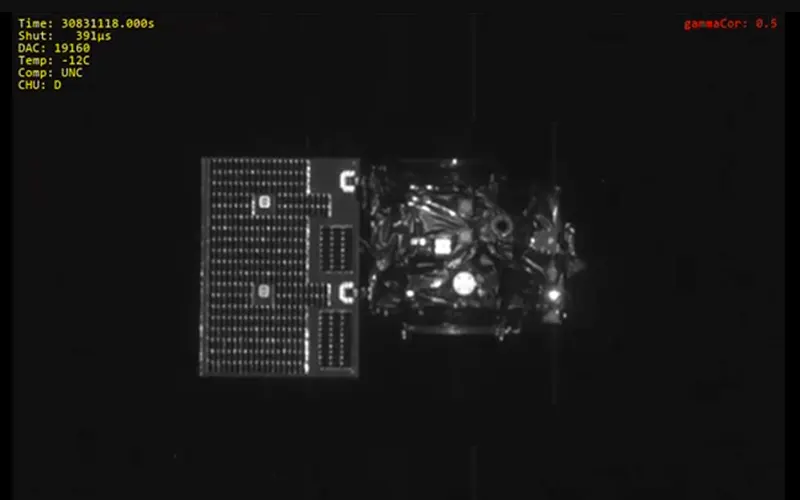
The European Space Agency announced on 6 March that it had lost contact with one of the two spacecraft that make up its PROBA-3 mission.
Both PROBA-3 spacecraft were launched aboard an ISRO PSLV-XL rocket in December 2024. The mission’s Coronagraph and Occulter spacecraft work in tandem, flying in precise formation to create and observe an artificial solar eclipse in orbit, enabling observations of the Sun’s outer corona.
Over the weekend of 14 and 15 February, the Coronagraph spacecraft suffered an anomaly that caused a chain reaction that led to a loss of attitude, which is its orientation. With its solar arrays no longer facing the Sun, the spacecraft’s onboard battery quickly discharged, triggering it to enter “survival mode,” where minimal electronics remain active, and data transmission to the ground is interrupted.
The agency is currently investigating the root cause of the anomaly. To aid recovery efforts, it is also assessing whether the second, healthy spacecraft could be used to safely approach and observe the orientation of the Coronagraph spacecraft.
The PROBA-3 spacecraft were built by a consortium of 29 companies led by the Spanish engineering group Sener, at a cost of approximately €200 million. The mission was designed to have a nominal lifetime of two years.
While the mission includes two satellites, both spacecraft work together to make scientific observations. The Occulter spacecraft carries a disk that blocks the Sun’s bright surface, creating an artificial eclipse, allowing the Coronagraph spacecraft to observe the Sun’s faint outer corona. Without the Coronagraph spacecraft, however, there is no instrument to observe the corona.
Keep European Spaceflight Independent
Your donation will help European Spaceflight to continue digging into the stories others miss. Every euro keeps our reporting alive.