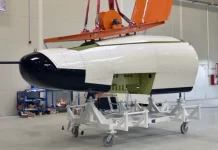
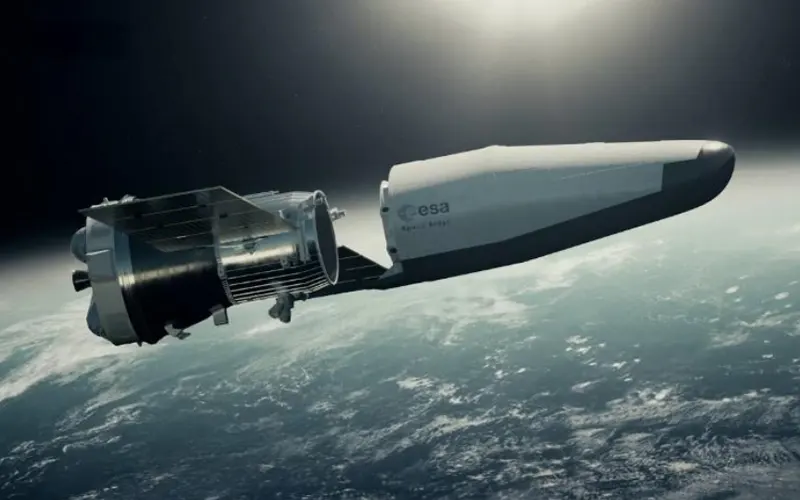
The Italian Aerospace Research Centre (CIRA) has completed key testing of the thermal protection system for the European Space Agency’s Space Rider spacecraft, showing it can withstand reentry even when damaged by micrometeoroids or orbital debris.
Space Rider is an eight-metre-long reusable spacecraft designed to carry payloads into orbit for missions of up to two months before returning to Earth. Thales Alenia Space is the prime contractor for the spacecraft’s reentry module and has subcontracted CIRA to develop and test its thermal protection system.
On 7 April, CIRA announced that it had successfully completed a testing campaign designed to evaluate how Space Rider’s thermal protection system performs under reentry conditions when damaged. The testing showed that, following severe plasma exposure, the dimensions of the damage remained unchanged, confirming the performance of the ISiComp ceramic composite material developed by CIRA and its partner Petroceramics.
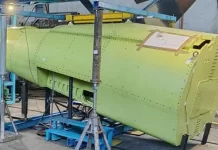
The test campaign focused on the spacecraft’s body flaps, which are used to control its attitude and stability during atmospheric reentry. The flap was first subjected to a high-velocity impact at the German Institute for High-Speed Dynamics (Fraunhofer EMI), which was designed to simulate a strike by a micrometeorite or orbital debris. It was then subjected to a severe thermal and structural resistance test inside the CIRA plasma wind tunnel, with temperatures of 1,200 degrees Celsius maintained for over 600 seconds.
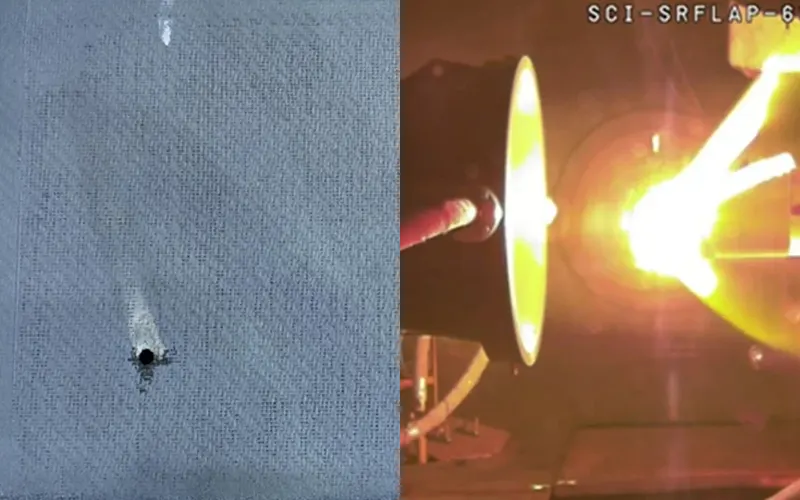
Following testing, the impact hole was inspected both visually and through non-destructive methods. CIRA found that the hole’s dimensions remained unchanged, validating the system’s resilience.
While this adds to a growing list of milestones, the Space Rider demonstration mission aboard Vega C is not expected to launch for another two years. Speaking to European Spaceflight in November 2025, Programme Manager Dante Galli explained that the flight was expected in the first quarter of 2028.
At the time, Galli added that the next big milestone in the vehicle’s development would be the final drop test, which he expected to be completed in February or March 2026. Now, moving into the second quarter of 2026, there has been no public confirmation that this testing has been completed.
While still a demonstration flight, the inaugural Space Rider mission will carry commercial customers. A total of 18 customers have signed Memorandums of Understanding with ESA to secure space aboard the mission, having been offered a discounted rate. Once this initial mission is complete, including the vehicle’s refurbishment, operational responsibility for the vehicle will be handed over to a commercial operator. While the recipient has not yet been selected, the agency is currently in discussions with two companies that could serve as Space Rider’s commercial operator.