
Munich-based space situational awareness startup Project-S has emerged from stealth with what it describes as “multi-million-euro backing.” The company is currently preparing for the first in-orbit demonstration of its active radar, with a spokesperson telling European Spaceflight that it is scheduled to be launched aboard a SpaceX Transporter rideshare mission next month.
On 2 September, Project-S publicly revealed its plans to develop systems capable of detecting smaller orbital threats and modelling their paths to “support safer satellite operations.” The company also disclosed that it had already closed a multi-million-euro funding round led by Greek venture capital fund Uni.Fund II. It added that the funding is being supplemented by non-dilutive support from the German government and “ESA-linked public innovation programmes.” The exact size of the funding round was not shared.
The company’s approach will be to use compact space-based active radar to detect and track objects in orbit. Project-S describes the software layer supporting those sensors as an “AI-enabled orbital-intelligence” system, which it says will be used to model object trajectories, assess collision risks, and provide satellite operators with information to support avoidance decisions.
“The space economy is becoming infrastructure. Safety must scale with it,” said Project-S CEO Leonidas Askianakis. “We founded Project-S to help operators understand smaller threats, make better decisions and keep orbital access open for the generations that follow.”
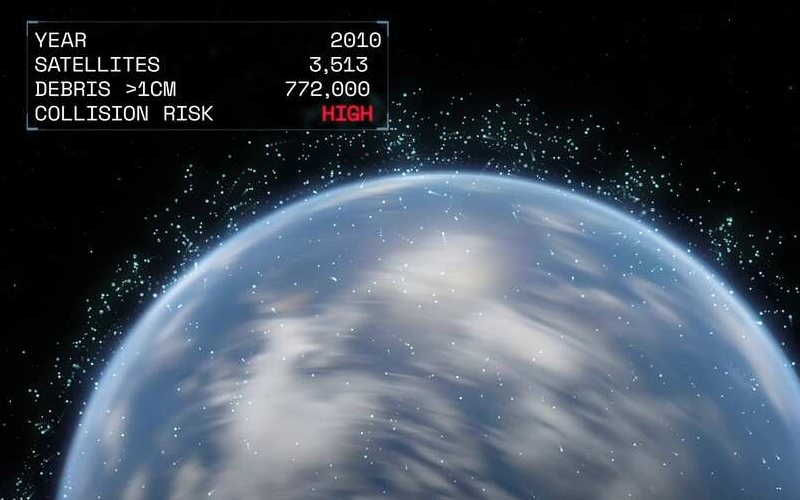
In ESA’s latest annual Space Environment Report, published in April, the agency estimated that there are around 54,000 objects larger than 10 centimetres orbiting Earth, 1.2 million objects between 1 and 10 centimetres, and 120 million between 1 millimetre and 1 centimetre. In its announcement, Project-S specifically highlighted the estimate for objects between 1 and 10 centimetres, suggesting that this size range is a particular focus of the company’s planned detection capabilities. The company describes objects in this range as difficult to track and “large enough to cause catastrophic damage in a collision.”
While the company said that the first demonstration of its space-based active radar would be launched next month, it did not provide a timeline for when the wider system could become operational.