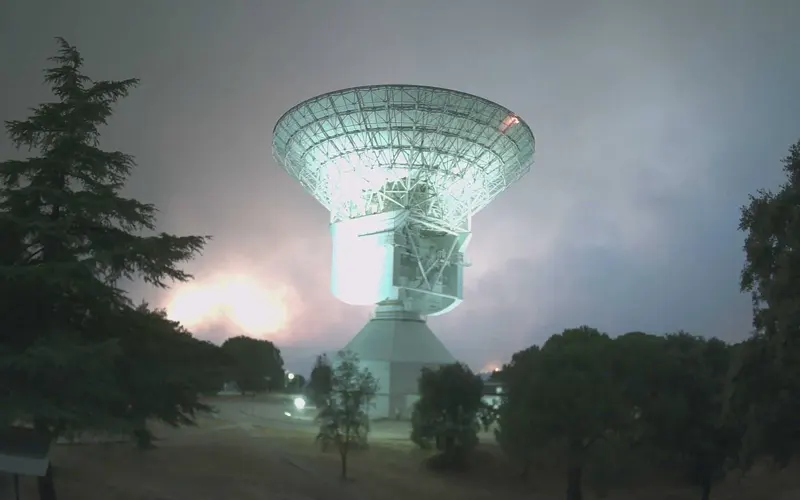
The European Space Agency Director General Josef Aschbacher announced on 26 July that the agency had cleared its Cebreros deep-space ground station in Spain to return to service after inspections confirmed that the facility escaped damage from wildfires.
Aschbacher explained that teams had completed the necessary checks and tests at the Cebreros station and cleared its 35-metre antenna to resume nominal operations from 27 July.
“After careful review, we have declared the antenna GREEN for nominal operations as of 27 July,” said Aschbacher. He added that any on-site presence would be kept to a minimum in accordance with restrictions that remain in force in the area.
The threat to the station was part of a wider wildfire emergency that began several days earlier. On Thursday 23 July, the Spanish government declared a national emergency as several large fires spread through the province of Ávila and neighbouring Madrid. The announcement stated that the wildfires had created a “particularly serious situation” due to their rapid spread and impact on inhabited areas. On 24 July, images began to emerge showing wildfires approaching ESA’s Cebreros ground station, with an evacuation order forcing staff to leave the site.
In a 25 July update, ESA said that wildfires had come “very close” to the station. At the time, the agency explained that it appeared to have escaped damage, adding the caveat that personnel had been unable to access the site to carry out a full inspection. ESA confirmed that all of its personnel were safe and accounted for, although a number of staff remained directly affected by “restrictions on access to their homes and concerns for family members.”
The Cebreros ground station is located approximately 77 kilometres west of Madrid and is one of ESA’s three deep-space ground stations. The other two are hosted at New Norcia in Australia and Malargüe in Argentina. Together, they form the deep-space component of ESA’s European Space Tracking (ESTRACK) ground station network that the agency uses to communicate with satellites and probes in deep space.