The UK Space Agency has missed a deadline to award a £75.6 million contract for the country’s first mission to capture and remove dead satellites from low Earth orbit.
A call for Phase 3 of the mission’s development was published in July 2025, with the contract initially expected to be awarded by 30 March 2026. However, in its final annual report as an independent entity, published on 14 July, UKSA admitted that the contract award had been delayed. The agency is now targeting summer 2026 but has not explained the reason for the delay or provided a more precise timetable.
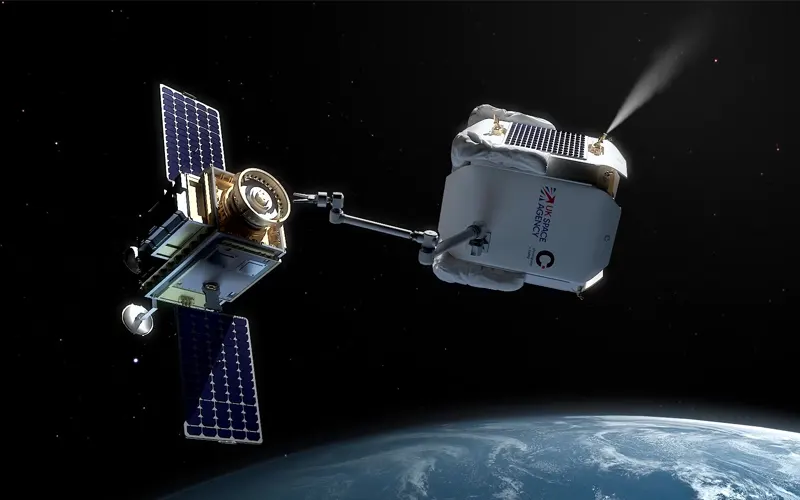
The Active Debris Removal (ADR) mission is expected to capture and remove two defunct UK-licensed satellites from low Earth orbit by the end of 2028. Neither satellite was designed to be removed from orbit, demonstrating the capture of unprepared, uncooperative objects in an increasingly congested orbital environment.
In the initial call for tenders, the agency estimated the total value of Phase 3 at £63 million before VAT, or £75.6 million including VAT. However, separate spending-control records published by DSIT, the department that now oversees the UK Space Agency, show that £83.93 million excluding VAT was approved for the Phase 3 mission in June 2025, which is £20.93 million more than the tender’s estimated contract value. Neither DSIT nor the UK Space Agency has explained what the additional approved expenditure covers.
Over the first two phases of the project, UKSA has funded the development of two parallel mission concepts led by the UK-based entities of Astroscale and ClearSpace. Their respective COSMIC and CLEAR mission concepts have progressed through feasibility studies, preliminary design reviews, and a second phase focused on maturing and de-risking critical technologies.
During Phase 3, UKSA is expected to select one of the two concepts for full development, launch, and in-orbit operations. UKSA has not said whether the delay in awarding the contract will affect the proposed 2028 launch date.