
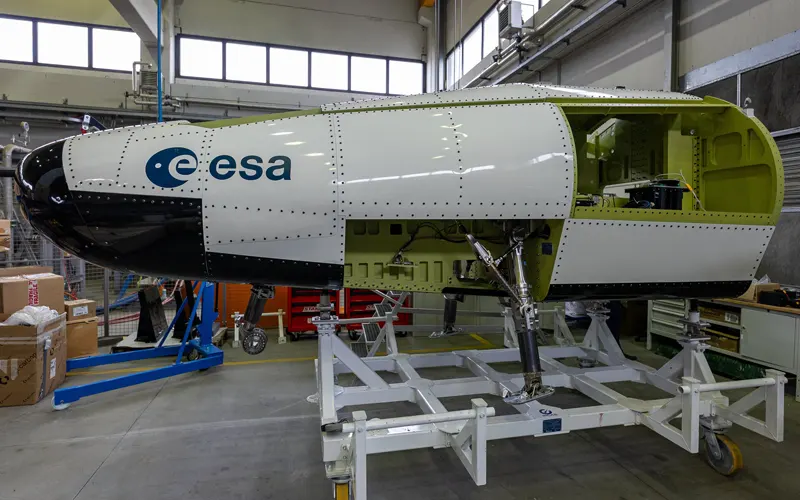
A full-scale drop test of ESA’s Space Rider spaceplane in early May was aborted after an anomaly during the captive ascent phase, the agency told European Spaceflight.
In August 2024 and June 2025, ESA completed Space Rider drop test campaigns using a 3,000-kilogram mass simulator. In early 2026, the agency planned to move forward with a final set of drop tests using the Descent and Landing Test Model, a full-scale mock-up of the Space Rider’s Re-entry Module that simulates its size, mass, aerodynamic shape, and landing gear.
In November 2025, Space Rider programme manager Dante Galli told European Spaceflight that the agency was targeting February or March 2026 to conduct this final drop test campaign. However, during a June 17 press briefing following the 347th ESA Council meeting, weeks after the aborted attempt occurred, ESA’s head of strategy and institutional launches for space transportation, Lucía Linares, explained that the agency could not provide a concrete date for the final drop test, stating only that it would take place after the summer and before the end of the year.
When asked what had prompted the several-month-long delay, an ESA spokesperson confirmed that the previously unannounced test campaign had taken place. According to the agency, the two-week campaign had concluded on 8 May, when the anomaly forced teams to abort the final test sequence.
According to the spokesperson, the anomaly occurred during the captive ascent phase. During this phase, the mock-up was raised to drop height by a CH-47 Chinook helicopter. The agency did not, however, provide details about the nature of the anomaly.
While an investigation into the anomaly is underway, it is neither the only nor even the primary factor driving the delay.
“The test vehicle has been carried back in a safe condition, and [the] investigation is ongoing,” the spokesperson said. “The final system drop test will be resumed not earlier than October 2026, due to test site availability constraints.”
Even with the slip to October, more than a year of margin remains before the inaugural flight, currently targeted for the first quarter of 2028 aboard a Vega C rocket. Additionally, in November 2025, Galli said that all flight hardware had been manufactured and was, at that point, either awaiting integration or undergoing verification testing.


transparency of what is being done with my tax Euros does not seem to be a priority at the European Space Agency.