The European Space Agency’s decision to assign Luca Parmitano to its first Artemis crew slot marked a departure from a November 2025 announcement that the opportunity would go to Germany, with the Italian astronaut’s test pilot background proving decisive.
In October 2020, ESA and NASA signed an agreement that would provide three flight opportunities for European astronauts aboard Artemis missions in exchange for ESA’s contributions to the Orion crew capsule and the Gateway space station. On 27 November 2025, ESA Director General Josef Aschbacher announced that the first of these flight opportunities would go to a German astronaut, in recognition of the country’s contributions to the agency’s Human and Robotic Exploration programmes.
“The first Europeans to fly on a lunar mission will be ESA astronauts of German, French and Italian nationalities,” said Aschbacher. “And I can announce today that the first flight will be allocated to a German astronaut.”
At the time, ESA’s first two Artemis crew allocations were expected to be for missions to the Gateway space station. However, during an update at its 24 March 2026 Ignition event, NASA paused development of Gateway in favour of building a base on the Moon’s surface, complicating ESA’s plans. It not only cast doubt on how the agency’s Gateway contributions would now be used to support its crew allocations but also raised questions about which Artemis missions European astronauts might ultimately be assigned to.
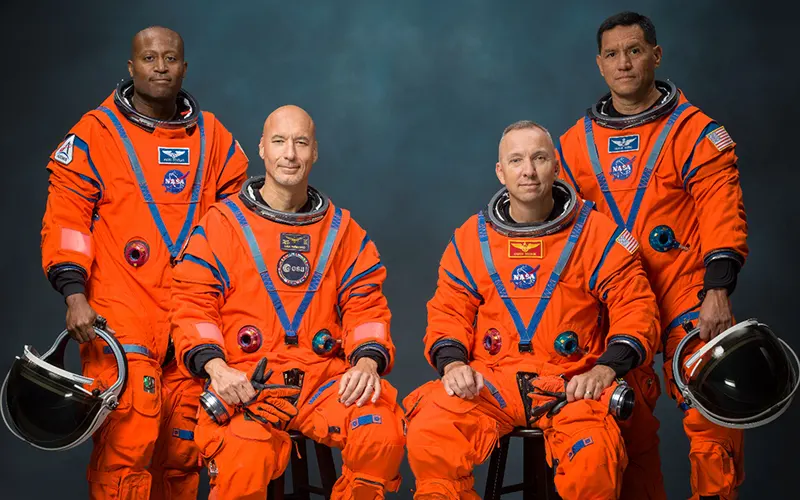
During a 9 June event at the Johnson Space Center, NASA announced the crew of Artemis III. The mission had initially been expected to be the first crewed lunar landing since the end of the Apollo programme in 1972. However, in February, NASA announced that it had retooled the mission to “test out systems and operational capabilities in low Earth orbit” ahead of the first lunar landing under the Artemis programme, now planned for Artemis IV in 2028.
The all-male Artemis III crew includes three NASA astronauts and ESA astronaut Luca Parmitano of Italy. Parmitano was assigned as the mission’s pilot, with Frank Rubio and Andre Douglas serving as mission specialists and Randy Bresnik as commander.
In an address following the announcement, Director General Aschbacher referenced Parmitano’s experience as a test pilot, his experience over two missions to space, and his cool under pressure, specifically highlighting an instance when, during a spacewalk early in his career, his helmet began to fill with water.
“Luca is precise, composed and determined. Yes, I am sure he brings a touch of Italian ease to the cockpit. He is exactly the right person for this role, and he is ready.”
When asked why an Italian astronaut had been selected ahead of the previously expected German candidate, an ESA spokesperson pointed to the revised mission architecture and said Parmitano’s test pilot experience had been decisive in the agency’s decision.
“Due to the revised nature of the mission, it required a specific profile for the astronauts joining the mission, and the capabilities [offered] by Luca Parmitano as test pilot were decisive for this role.”
While Parmitano is not the only test pilot listed among ESA’s astronaut corps, he does appear to be the most obvious candidate for selection. Most notably, France’s Sophie Adenot served as a helicopter test pilot and is currently aboard the International Space Station on her first mission to space, meaning she was likely unavailable for consideration for Artemis III so soon after being assigned to her debut flight. The only others with comparable test pilot credentials, Sweden’s Marcus Wandt and Italy’s Andrea Patassa, are both members of ESA’s astronaut reserve and, as a result, likely not eligible for Artemis crew selection consideration.
During a press briefing at ILA Berlin on 11 June, Director General Aschbacher suggested that the November 2025 crew allocation plan was no longer applicable because it had been based on a different programme architecture.
“These three flights announced at that time, of course, were valid for the announcement in Bremen at that time,” he said. “Today we have a new situation because Gateway is paused. Therefore, we really have to start negotiating now what to do next.”
The exact nature of the agency’s continued involvement in the programme is yet to be decided. Speaking to European Spaceflight in April, an ESA spokesperson explained that the issue would be discussed at the agency’s Council meeting later this month.
“ESA is carefully evaluating the potential repurposing of its various contributions, taking into account their development maturity and strategic value,” said the spokesperson. “This analysis is ongoing. In June, ESA will present Member States with a clear proposal on the way forward. Our goal is to agree a path that is ambitious, coherent, and attractive to Member States and international partners alike.”
However, in his 9 June address, Aschbacher appeared to signal that there was still political will within ESA to remain involved in Artemis despite the uncertainty.
“Our 23 Member States are aligning to step up in exploration,” said Aschbacher. “Because when you choose to be part of something as ambitious as Artemis, you contribute. That is what we do – what we will continue to do.”
Update: This story was updated on 12 June to include additional comments from ESA Director General Josef Aschbacher on seat allocation negotiations and Europe’s continued role in Artemis.